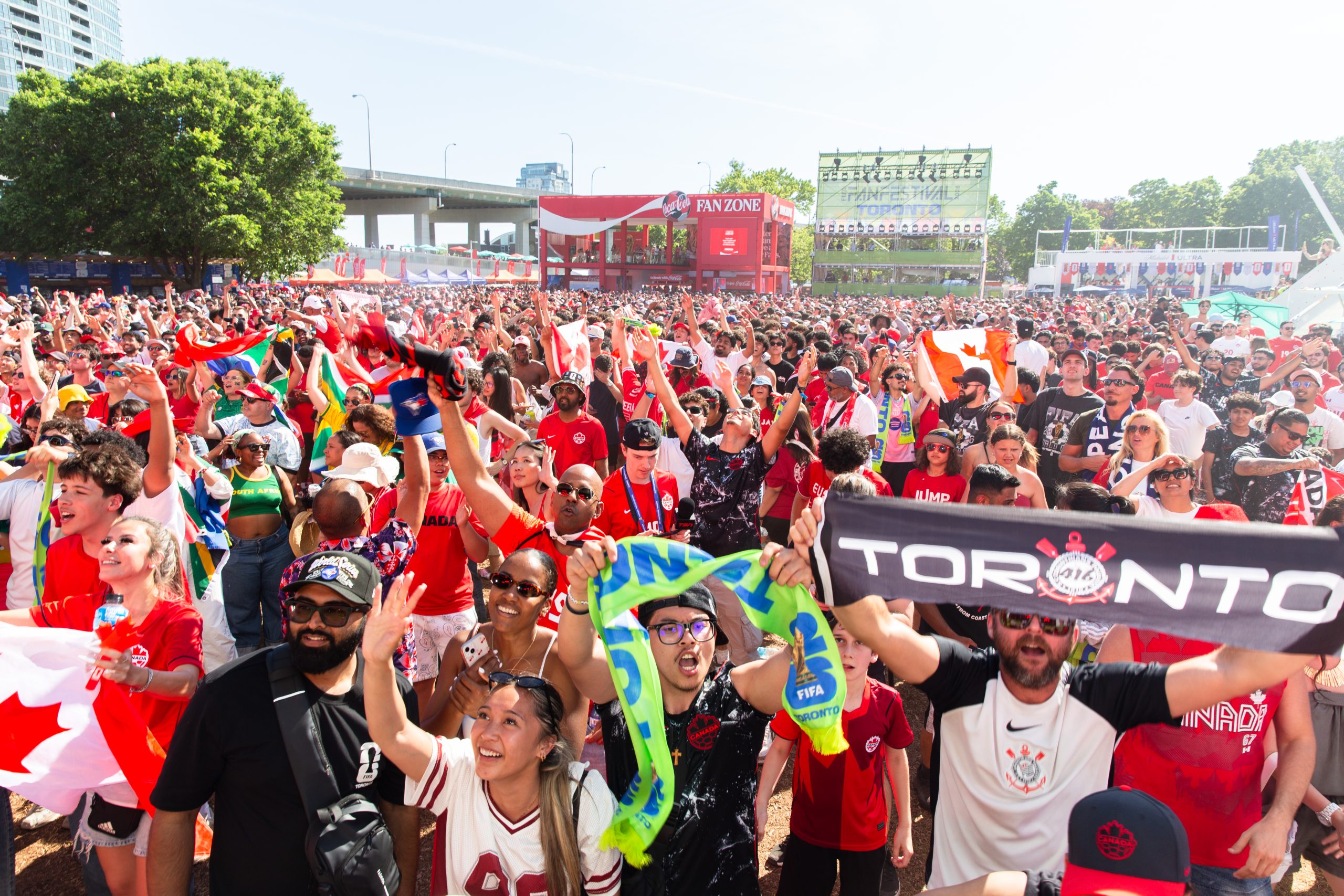

“The world in a city” was Toronto’s official slogan for the 2026 FIFA World Cup as one of 16 host cities.
Toronto is often recognized as the most diverse city in the world, with more than half of its residents born outside Canada and more than 200 distinct ethnic groups represented in the population. Outside of hosting the World Cup, Toronto draws millions of tourists every year.
So, diversity in this city is by no means new, but seeing and feeling it this World Cup has been special.
Psychotherapist Jhanelle Peters says people’s experiences around the World Cup contribute to a sense of wellness. In addition to her regular practice, Peters has extensive experience in elite sports environments, notably as the former mental health clinician for the Toronto Raptors.
She says factors that contribute to someone’s sense of well-being, aside from rest, are food, movement and social connection.
“The World Cup creates such a large portion of that element of well-being because it creates social connection by even just walking down the street, and like looking at things.”
Parades complete with drumming and chants ahead of big soccer games are a European tradition that was imported to host cities across North America for the tournament. Thousands of fans gathered for a “March to the Match” when Canada played Bosnia and Herzegovina in Toronto, the first men’s World Cup game played in this country.
Predictably, Canadian fans came out in droves to support the team. But I was surprised to also see thousands of people draped in the blue of Bosnia chanting and parading through the streets. There were also massive crowds when Ghana and Germany had matches in the city during the group stage. As well as for the round of 32 match between Cristiano Ronaldo’s Portugal and the Luka Modric-led Croatia.
Crowds were made up of local diaspora members, tourists, and people just there for the spectacle.
Throughout the tournament, the elements of well-being were compounding, Peters says, contributing to people’s mental wellness.
“Social connection and well-being are so paramount in order for us to feel like ourselves and to feel like we have a purpose,” she said.
Peters says the World Cup creates moments of connection both intentionally and unintentionally. And right now, we desperately need to feel connected.
The tournament arrived at what feels like an incredibly divisive time around the world.
Here in Canada, people in Alberta are actively considering whether or not they want to start the process to break up the country while people in Quebec are once again flirting with the idea of separation.
Two days into the tournament, eight people were arrested during anti-immigration and counter-protests held in England. The demonstrations came just a few days before the 10th anniversary of the Brexit vote and Prime Minister Keir Starmer’s resignation. The United Kingdom has had seven leaders in the last decade, and many argue the country is still dealing with the fallout from Brexit.
Anti-immigration protests have happened regularly throughout the U.K. since spring 2025. This disgusts me as a person but baffles me from a soccer perspective considering a lot of England’s best players are Black or from immigrant families, like Jude Bellingham and Bukayo Saka.
Saka scored a hat trick in the bronze-medal game against France and provided three assists at this World Cup. He was born in London to Nigerian immigrants. He was one of three England players who faced vicious racial abuse from so-called fans after they missed penalties in the finals of the European Championships in 2021.
U.S. Vice President J.D. Vance encouraged one of the anti-immigration rallies back in May, calling on demonstrators to “keep on going.” Meanwhile, four people in the U.S. have been shot dead by U.S. Immigration and Customs Enforcement agents this year, including two incidents that happened while the country was hosting the World Cup; ten in total since the immigration crackdown began last year.
With ICE deployed across the U.S., including host city Los Angeles, and reports of agents wrongfully targeting people leading up to the tournament, tourists and local racialized people expressed concern around gathering for games in public.
That fear paired with the political turmoil we’re all feeling is part of the reason why celebrating during this World Cup felt so good; it almost felt necessary. Embracing joy felt like an act of rebellion.
Peters says the desire to feel connected and rooted instead of different or like “the other” is particularly powerful for racialized people.
“Being a Black person, I definitely notice when I’m the only Black person in the room. But imagine being so used to that and going to a space and there’s ‘me’ everywhere. I hear us everywhere, I see us everywhere; I taste it in the food,” Peters said. “It’s almost like you take off like an armour, and you take down your guard. You feel safe with your people. You feel safe with your community.”
I could’ve chosen to completely boycott the World Cup over my extreme distaste for Trump or FIFA’s shameful handling of this tournament (pricing fans out of experiencing the beautiful game, relegating Canada and Mexico to junior hosts, the introduction of a halftime show during the final and “hydration” breaks every game, suspended red card bans for Cristiano Ronaldo and Folarin Balogun) but I would’ve missed out on some memorable moments.
During the contentious game between Egypt and Argentina in the round of 16, I learned that “Misr” – pronounced like maas – is the Arabic name for Egypt. Egypt supporters were chanting it to the beat of a drum in front of the giant screen at Nathan Phillips Square, steps away from City Hall.
I watched the round of 32 clash between Mexico and Ecuador at a Mexican restaurant downtown called Tulum. I sipped on a tequila-based drink, and I asked my server what meal I should order to have the most authentic culinary experience possible. She recommended nachos with a side of Choriqueso.
One man I spoke to that night told me he was visiting from Mexico and in town to visit his adult children. Someone else I spoke to there was born in Mexico but spent most of her life in Vancouver. She showed me some basic salsa dance moves and told me about the geopolitical tension between Ecuador and Mexico stemming from a diplomatic dispute.
My first time at the FIFA Fan Festival, I met a guy named Brennan who I learned was a farmer and business owner. He was a burly-looking white guy with a thick beard from Michigan. There was a part of me that wondered and worried, honestly, that he might be a MAGA-loving Trump supporter.
So when he apologized for the political tension that’s emerged between Canada and the U.S. and denounced some of Trump’s actions unprompted, I felt relieved but also a little embarrassed.
I could’ve let stereotypes lead me to put up a wall and keep me from connecting with a fellow soccer fan. Brennan introduced me to his German friend Oli, who I suspect is an executive in the soccer world. They shared that they met travelling Europe 13 years earlier but hadn’t seen each other since. They’re both Germany supporters, so when Oli heard Die Mannschaft were playing in Toronto against Ivory Coast, he got tickets and invited Brennan.
They were basically only in town for two days, but both said the opportunity to see a World Cup game and each other was too good to pass up. I told them they should check out WVRST, a German-style pub, near the Entertainment District before they leave.
To me, that moment highlighted one of the reasons why soccer is called the beautiful game; it brings people together in a way few other things in the world can.
So while sayings like “diversity is our strength,” and other platitudes can feel empty coming from politicians and people in power who talk about supporting immigrant and racialized communities without taking concrete action, it is absolutely a strength and it was lovely to see over the last 40 days.
We see the strength of that diversity on Canada’s own men’s team.
Stephan Eustáquio, the hero from the round of 32 game against South Africa, was born in Leamington, Ontario. When he was seven years old, he and his family moved back to Portugal before he eventually decided to represent Canada at the senior level.
Jacob Shaffelburg was born and raised in Port Williams, Nova Scotia; meanwhile, captain Alphonso Davies was born to Liberian parents in a Ghanaian refugee camp before his family relocated to Edmonton.
England midfielder and one of the darlings of the tournament, Jude Bellingham, posted on social media following England’s loss to Argentina in the semi-finals.
“Don’t let the unity and love we’ve seen in our country end with this campaign. When we’re together we can achieve big things…” he wrote.
The World Cup may be over, but we must keep that same energy.

Marcus is a poet, editor and freelance journalist based in Toronto. He currently works with New Canadian Media as an Editor and as a Freelance Writer for ByBlacks.com, The Edge: A Leader's Magazine and The Soapbox Press.