On a spring afternoon, wearing Colombia’s bright yellow jersey, a nine-year-old Mattia Matallana Cortes of London, Ont., pops a soccer ball from his knee to his foot before flicking it into the air and sending it skipping across the pitch. He races after it with the certainty of someone who already knows what he wants to be.
In the summer of 2026, he watched Colombia’s World Cup dream go up in smoke. He was heartbroken. He then made himself a promise.
One day, he would play for Colombia.
His father smiles when he tells the story. But the father then quietly offers a different dream.
“I hope he plays for Canada.”
The two dreams are not opposite in Canada’s multicultural context. One looks back to the family’s roots; the other looks towards the country where the boy is growing up. Together, they pose a question that is familiar in every immigrant household across Canada, but has found new resonance in the wake of the FIFA 2026 World Cup: Must belonging to one nation come at the expense of belonging to another?
Daniel Bernhard sees no contradiction between Mattia’s dream and his father’s hope that he might one day represent Canada. As the chief executive officer of the Institute for Canadian Citizenship (ICC), Bernhard said Canada’s strength lies in allowing newcomers to become Canadians without abandoning who they already are. Allowing people to hold two national identities, he said, “makes the family and the country richer and more interesting.”
Nick Bontis understands that idea not only as a former president of Canada Soccer but also as the son of Greek immigrants. Growing up, he said, he never viewed his Greek heritage and Canadian identity as competing loyalties. “Those loyalties don’t compete with one another,” he said. “In many cases, they strengthen one another. That’s the magic of being Canadian.”
If Bernhard explains why Canada can embrace more than one national identity, Simon Darnell explains why soccer has become one of the clearest arenas in which people negotiate multiple identities. A University of Toronto professor whose research examines the sociology of sport and its relationship to globalization, citizenship and race, Darnell said while sport has long celebrated national identity, today’s game increasingly reflects what he calls “hybrid national identities.”
Globalization has made those identities more common and fluid, he says, as migration allows families to build lives across borders, while maintaining deep emotional, cultural and familial ties to the countries they left behind. International soccer offers one of the few public stages where those layered identities are openly expressed, not because sport creates them, but because it makes them visible.
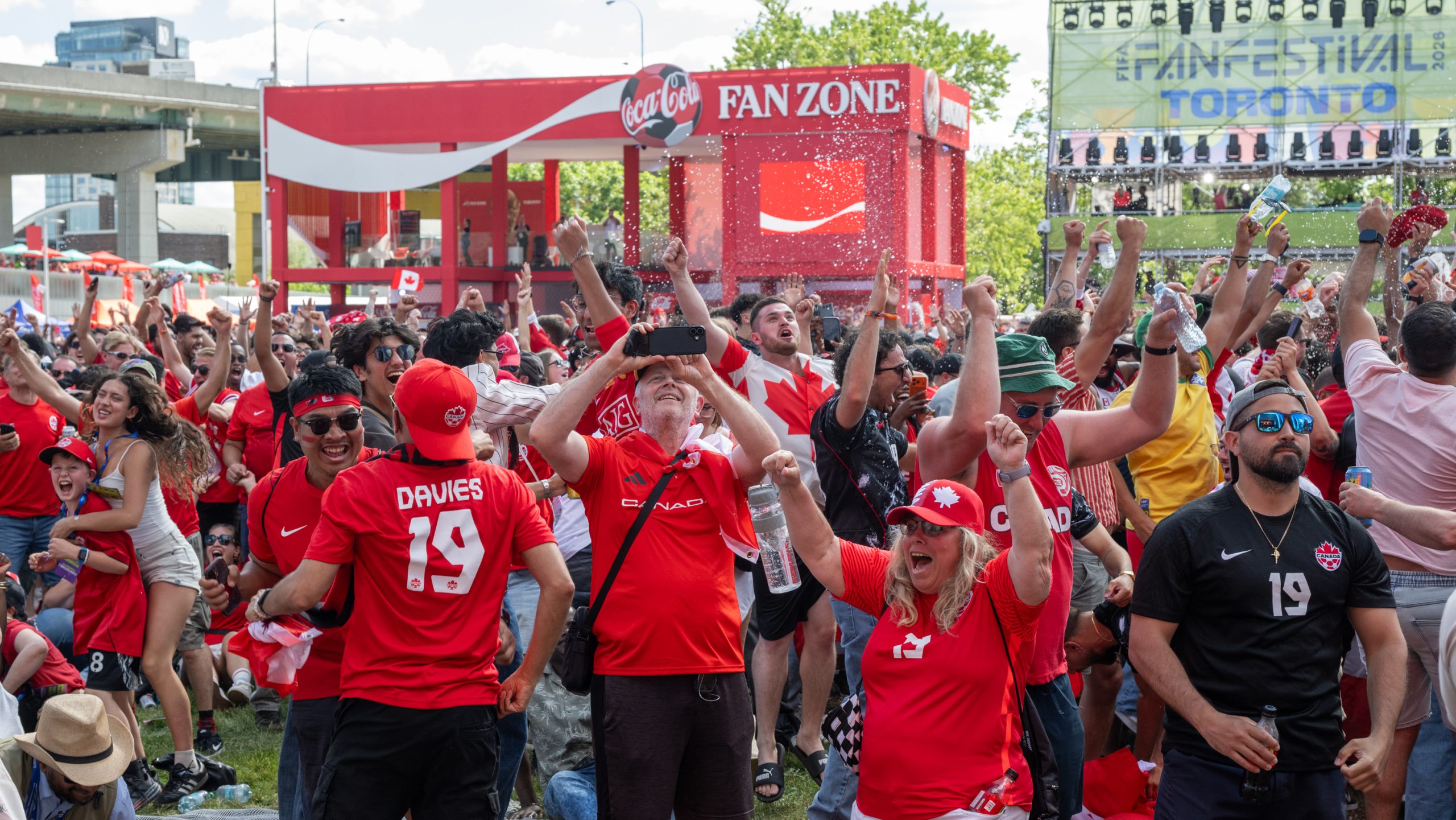
Bontis, also the chair of strategic management at McMaster University, witnessed that reality during the 2026 FIFA World Cup. At Canada’s opening match, he recalled seeing supporters wearing jerseys sewn together down the middle – half Canada, half another country — to symbolize identities they did not see as conflicting. The image, he said, captured the idea that people need not choose between the country of their heritage and the country they now call home.
That helps explain why Mattia can dream of wearing Colombia’s yellow jersey while his father quietly imagines a future in Canada’s red and white. The difference is less a family disagreement than a reflection of the dual worlds a nine-year-old already inhabits. One is the homeland passed down through family stories, language and soccer. The other is the country where he is growing up, making friends and learning the game. Neither identity has displaced the other.
In Bernhard’s view, people routinely balance multiple identities: as parents, neighbours, professionals, people of faith and language – and national identity is no different. Holding more than one sense of belonging, he says, need not diminish either one.
From different perspectives, Bernhard, Bontis and Darnell arrive at the same conclusion: belonging is not a zero-sum, trade-off proposition. Bernhard said Canada’s approach to citizenship allows people to contribute to something larger than themselves without giving up who they are.
Bontis, who currently serves as vice president of Concacaf, said Canadian identity is defined less by birthplace, ethnicity or family history than by a shared commitment to the country. Darnell sees that reality reflected on the soccer field, where players often embody more than one national story and where representing Canada has become an expression of an identity that is expanded rather than replaced.
In his view, Canada’s diverse national soccer team is not redefining the country so much as reflecting it. In a multicultural society shaped by immigration, he says, teams composed of players whose families come from around the world tell an eloquent story about Canada as an inclusive and accessible place.
For Mattia, however, these ideas remain largely invisible. He is not thinking of multiculturalism, civic identity or globalization. He is thinking about the next training session, the next match on television and the next chance to play. Asked where he hopes to represent one day, he answers without hesitation: Colombia. The possibility that he might also one day wear Canada’s colours belongs, for now, to his father’s dreams rather than the boy’s own.
Bernhard argues that coexistence fortifies Canada. Bontis reaches much the same conclusion from personal experience. “I would tell him he does not need to make his heart smaller in order to belong,” he said of a child like Mattia. “He can love Colombia because it represents his family … He can also love Canada because it is where he is growing up.”
Belonging, Bernhard emphasizes, ultimately strengthens everyone. It is not simply something extended to newcomers, but an investment in the country itself. When people believe they are genuinely part of Canada, they are more likely to contribute to it, enriching the communities they join. Darnell echoes that broader idea, arguing that “recognizing and celebrating differences can almost, paradoxically, become the very thing that binds a diverse society together.”
Years from now, Mattia may face the kind of choice that confronts a handful of elite footballers with ties to more than one country – choosing one jersey over the other. Or he may not. For now, that decision lives only in imagination. What already exists is something Bernhard, Darnell and Bontis all recognize: a young Canadian with two homelands, finding no contradiction in loving both. Like the supporters Bontis watched wearing colours stitched together down the middle, Mattia has no reason to make his heart smaller to belong.
Aloa Alota
Aloa Alota is a recipient of the 2025 Press Freedom Hero Award from the Gambia Press
Union. He is author (with Demba Ali Jawo) of A Living Mirror: The Life of Deyda
Hydara, which examines journalism, power, and risk through the life of the slain
Gambian journalist - Deyda Hydara. The work has been endorsed by Reporters Without
Borders (RSF) and adopted by the Open Society Initiative for West Africa (OSIWA) as
an advocacy text on freedom of expression in Africa. He holds a PhD in Media Studies
from Western University, London, Ontario.