A Tibetan architecture-inspired 13-storied mixed-use residential building housing a Buddhist temple has been approved in Parkdale, Toronto. While there are a few examples of residential buildings attached to Christian churches, this new design is perhaps the first of its kind in North America.
“As far as I know, this is the first building of its kind in Toronto, and it may well be unique in North America, combining a purpose-built Tibetan Buddhist temple and community space with a substantial residential development,” said Prof. Sarah Richardson, who teaches the history of religion at the University of Toronto Mississauga, in a statement to New Canadian Media via email.
She also says that “the building seems to express something about the experience of diaspora: an effort to preserve and make visible a distinctive Tibetan religious and cultural identity while adapting it to a very different urban environment.”
Similar views were expressed about the new building’s design by Diana Chan McNally, who is a member of the City of Toronto’s Housing Rights Advisory Committee and is running to be the next city councillor of Parkdale-High Park.
“It’s absolutely wild. I don’t think I have seen anything like it,” says McNally.
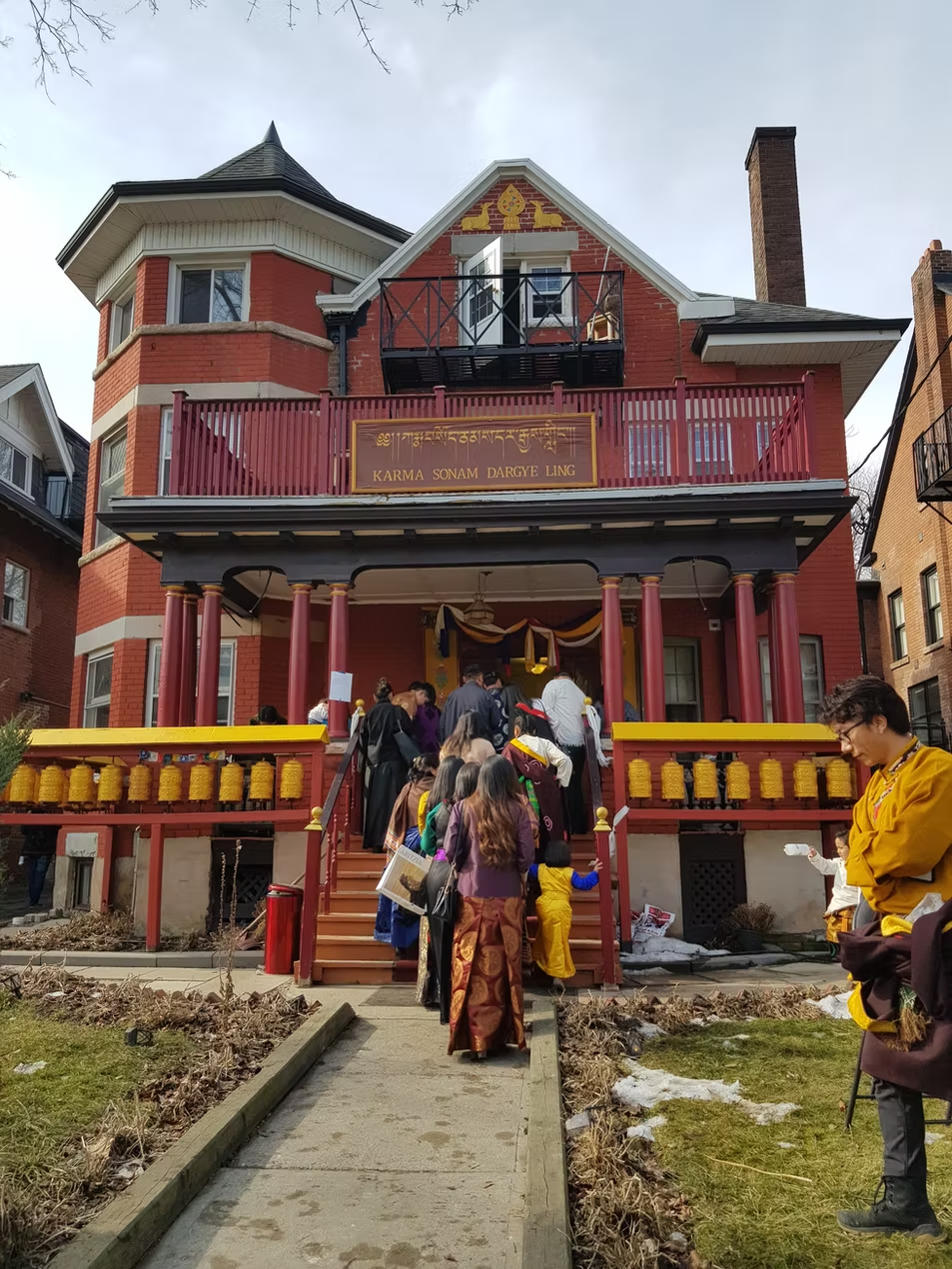
The new building will replace 1464 W King Street, which is currently a three-storied Tibetan Buddhist temple, and the two neighbouring properties, both of which are owned by the Karma Sonam Dargye Ling (KSDL) temple.
Lama Tenzin, the president and abbott of the temple, says that the city never objected to constructing a mixed-use residential and religious building.
Dr. Tsering Shakya, the Canada Research Chair in Religion and Contemporary Society in Asia at the University of British Columbia, specializing in Tibetan Studies, commented on the significance of the approval for the new building in inner-city Toronto. Dr. Shakya, who is also Tibetan, said that city planners usually give permission to build temples on city outskirts under the assumption that people go to the temple only on weekends.
“That is not possible; we don’t do that. We visit every day. We don’t only have service on Sundays,” says Dr. Shakya.
The distant locations of temples keeps them from serving the communities, especially the elders, he adds.
Though he was not a part of this project, Dr. Shakya also said that there are a growing number of elderly Tibetans who need social housing.
Marek Rozkowski, the owner of High Park Architects and the designer of the building, said that though he hasn’t seen any building like this in North America, he and Lama Tenzin drew from examples of high-rise buildings in China and Taipei.
To create the illusion of Tibetan monasteries on mountain tops, the building is divided into three parts with the base being the broadest, the middle, residential block being narrower, tapering further on the floor housing a new temple structure which will still follow Tibetan monastic traditions.
Rozkowski said there will be a large terrace on the eighth floor which could also be used to do kora, the circumambulation around Buddhist temples.
Both Lama Tenzin and McNally also pointed out that there is a lack of daycares in the neighbourhood and having a daycare in the building would help families.
Similar plans to construct an urban village centre for the Islamic community have been designed by the Al-Rashid Foundation in Edmonton.
“Little Tibet”
Last year, when the application was submitted some residents in the area had expressed disapproval because the new construction requires cutting down an old maple tree. This continued after the arborist report submitted in the application had shown that the tree was not in good health.
On July 8, the outgoing city councillor of the neighbourhood, Gord Perks, said at the council meeting that the applicant (KSDL) has worked incredibly closely with city staff and has been very flexible. He also noted that the approvals process has been a long journey.
“I wish it were possible to redevelop properties for good social purposes like this one without any impacts on the community, but sometimes there are impacts. The trees in question, our arborists have gone and looked and they are comfortable in our decision to remove them,” said Perks.
The sizable population of Tibetans has popularized Parkdale as “Little Tibet.” And as Tibetans continue to face extermination attempts by the Chinese government, it has become more important for those who live outside to preserve Tibetan culture.
“On the other hand, the Chinese government is the most strong, powerful country that is trying everything to destroy. Our population is so small. It is very difficult to preserve, maintain. So, we do need a place like this to preserve our language and religious practice,” says Lama Tenzin.
“There is something quite powerful about seeing traditional Tibetan architectural forms becoming part of the skyline of contemporary Toronto, and I look forward to seeing how the project progresses.” says Prof. Richardson.

Aadya Arora is a Vancouver-based journalist interested in covering immigration, labour and women's stories as well as exploring Canadian nation-building practices.