
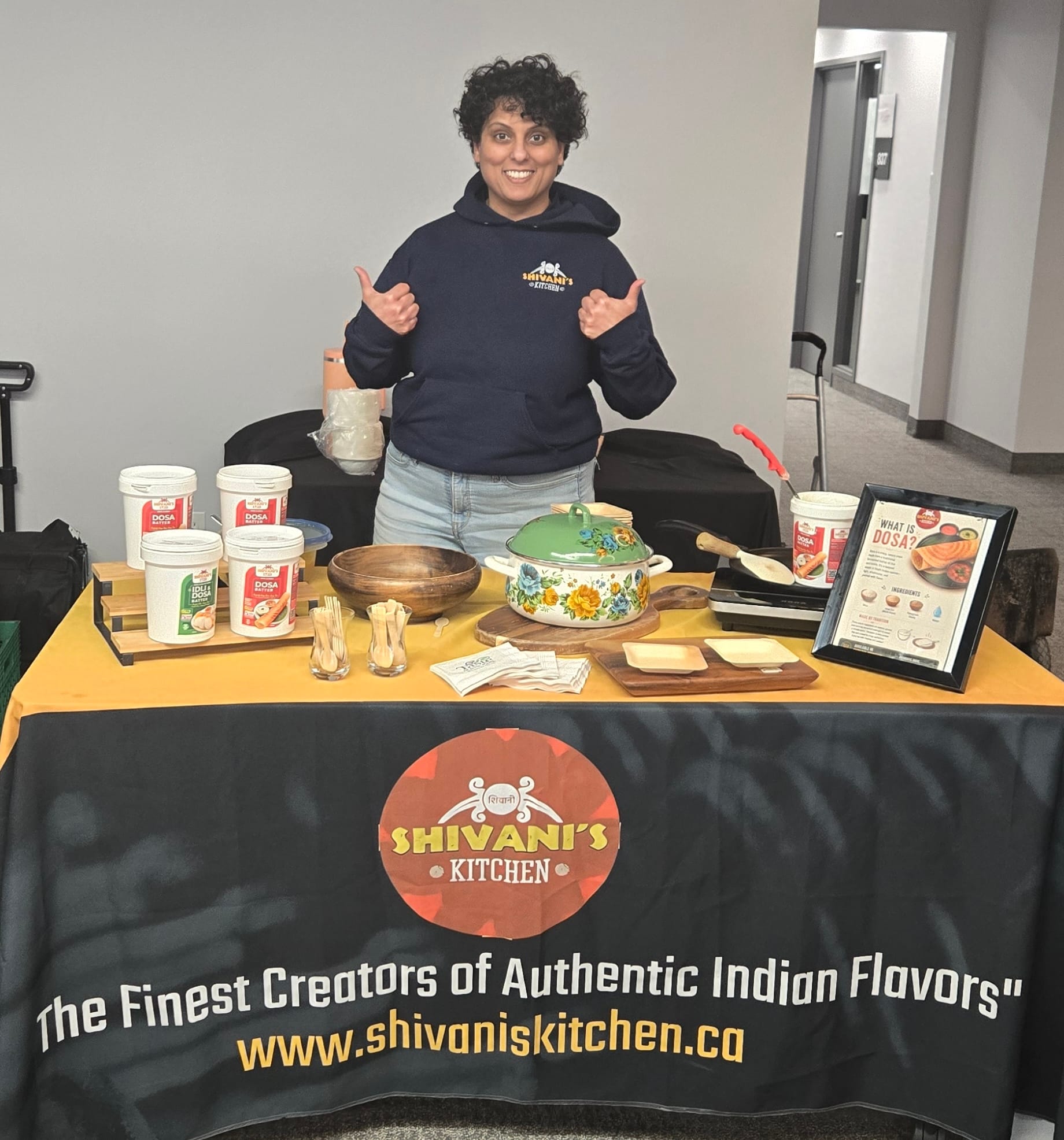

When Shivani Dhamija’s paneer reached roughly 1,000 grocery stores and helped push her Halifax food company’s annual revenue to about $1.5 million, demand was not the problem.
The harder part, she says, was trying to scale within a Canadian food-manufacturing system that requires small companies to build many of the compliance, infrastructure and financing systems expected of much larger producers — before they have comparable sales or cash flow. These systems, for example, regulations that ensure Canadian food products are safe, help create important guardrails, but they can also create major challenges that prevent smaller players from scaling up to compete for larger markets.
“Food safety is necessary,” Dhamija said. “The difficulty is that a small company has to operate almost like a large manufacturer before it has the volume or cash flow of a large manufacturer.”
Her experience highlights a difficult transition faced by growing food companies: moving from a founder-led business with a popular product into a manufacturer capable of supplying major retailers across Canada.
That transition can require specialized facilities and equipment, federal licences, risk control plans, traceability and recall systems, shelf-life testing, compliant labels, independent food-safety audits and access to refrigerated storage and transportation.
For Dhamija, who began with a home-based business in Halifax more than a decade ago, success required repeated reinvention.
She started Shivani’s Kitchen around 2013, initially offering home delivery before moving into offering cooking classes. After noticing that Halifax restaurants often relied on packaged naan instead of making them in house, she travelled to Toronto to learn how to make it and opened her restaurant in 2018.
When the restaurant closed during the COVID-19 pandemic, she started a company that sold consumer packaged goods.
The company first tried selling spices, but Dhamija said it struggled to compete with lower-priced products imported primarily from India and Pakistan. Its fresh sauces found customers, but selling them frozen presented another challenge: consumers did not always know to look for sauces in the freezer aisle.
Paneer changed the company’s trajectory.
Production grew from about 100 kilograms a week to roughly 3,000 kilograms. The cheese was eventually sold through Costco, Loblaws, Walmart and Sobeys, reaching approximately 1,000 locations at its peak, according to Dhamija.
But Shivani’s Kitchen could not make the paneer in its own facility because it did not have approval to manufacture cheese. The company therefore relied on a contract producer with the required dairy infrastructure.
Dhamija said the arrangement ended abruptly, halting production and removing the paneer from store shelves. She did not identify the manufacturer.
The episode exposed the vulnerability of building a fast-growing product around facilities and equipment controlled by another company. But establishing an independent operation would require a different scale of investment.
Dhamija estimates that creating the kind of facility she wants could cost about $3 million. Dairy production cannot begin with a single machine, she said: separate equipment is needed for pasteurization, processing, cooling and storage, alongside testing, sanitation and record-keeping systems.
Federal requirements add to the sprawling regulatory regime.
The Canadian Food Inspection Agency says businesses that manufacture, process, package or label dairy products for sale across provincial borders must meet licensing, preventive-control (to mitigate a range of potential hazards), written preventive-control-plan and traceability requirements.
Major retailers may also require independent third-party food-safety audits before accepting a product, Dhamija said. Preparing for those audits can take months, even though the inspection itself may last only two or three days.
She said this creates a costly gap: a small manufacturer needs significant facilities and compliance systems to secure national vendor contracts; but may need revenue from those national contracts before it can afford those systems.
Shivani’s Kitchen is one of the many small employers operating in the sector.
According to Innovation, Science and Economic Development Canada, Canada had 6,905 food-manufacturing establishments with employees in 2025. About 90.6 per cent employed fewer than 100 people.
Nova Scotia had 232 food-manufacturing employers. Of those, 68 had between 1 and 4 employees and another 142 employed between 5 and 99 people.
Shivani’s Kitchen currently employs four full-time and three part-time workers. Dhamija expects its annual revenue to reach approximately $1.2 million this year, down from the roughly $1.5 million it earned at the height of paneer sales.
Operating in Atlantic Canada brings an additional set of limitations, she said.
Larger manufacturing centres have more co-packers, cold-storage warehouses, refrigerated trucking routes, packaging suppliers, ingredient suppliers and distributors moving products frequently. Those services exist in Atlantic Canada, Dhamija said, but there are fewer providers and less frequently staffed transport routes.
The cost of building compliance systems can therefore be much higher for smaller markets, compared to the costs for similar manufacturers in Ontario or Quebec.
Selling beyond Nova Scotia can expand the company’s potential market, but it also requires manufacturers to meet the federal licensing, traceability, labelling and preventive-control requirements that apply to food traded across provincial borders. Dairy products add the cost and complexity of refrigerated storage and transportation across long distances.
Those challenges remain, even as governments have moved to reduce other internal trade barriers. Canada’s new mutual-recognition agreement allows many goods approved for sale in one province or territory to be sold elsewhere without additional testing or certification. But food and beverages were excluded from the agreement, Global News reported in January 2026, leaving food manufacturers outside one of the country’s most significant recent internal-trade reforms.
For companies such as Shivani’s Kitchen, that means expanding nationally still requires navigating food-specific federal requirements, provincial systems and the practical costs of moving perishable products between distant markets.
Dhamija said Canada’s supply-managed dairy system also makes milk different from an ordinary ingredient that a manufacturer can purchase freely from any supplier. In Nova Scotia, milk production, transportation and farm-gate pricing operate within a provincially administered system.
The result, she says, is not one rule blocking growth but several systems — regulation, financing, manufacturing, distribution and retail — converging at the same stage.
“Small business owners already know how to do business,” Dhamija said. “We know our products, our customers, our sales opportunities and our market.”
But when they try to grow, she said, they must suddenly become experts in food-safety documentation, federal paperwork, export rules, grant applications, distribution, logistics, labelling, packaging, financing, audits and retailer onboarding.
“That is where many small companies get stuck,” she said. “It is not because we lack ambition. It is because the paperwork and systems required to grow take time away from actually growing the business.”
For immigrant entrepreneurs, those obstacles may begin before the business reaches the scaling stage.
Securing the right to come to Canada can itself become a prolonged hurdle. New Canadian Media previously reported how delays under the federal Start-Up Visa program left entrepreneurs waiting years for decisions and unable to plan their futures with certainty.
As the backlog grew, some founders said their temporary immigration status restricted their access to business credit and government grants, while uncertainty damaged investment decisions, family plans and their ability to expand.
Entrepreneurs caught in the program have since pressed Ottawa for faster decisions and the return of limited work permits, arguing that immigration uncertainty can cost founders business momentum, hiring opportunities and investor confidence.
Dhamija’s experience is an example of a different, later stage in the immigrant-entrepreneur journey. Even after settling in Canada, starting a company, building revenue and demonstrating consumer demand, a founder must still find the capital, infrastructure and expertise needed to turn a small business into a national manufacturer/producer.
Dhamija believes stronger food-business incubation infrastructure could help bridge that gap.
Small manufacturers need access to shared production facilities, pilot plants, commercial kitchens, dairy rooms, frozen storage, packaging equipment, technical advisers and food-safety experts, Dhamija said. These facilities can allow companies to test products, increase production and build compliant systems without immediately investing millions of dollars in their own plants.
Some Canadian municipalities are beginning to experiment with that model. A new shared commercial kitchen opened in Brampton in April, giving chefs, caterers and food startups access to public health-certified space for about $35 an hour. The facility is also intended to operate as a food-business incubator, offering training on regulatory compliance, pricing, food safety, labelling and packaging.
“Many immigrant entrepreneurs are very good at identifying opportunities, creating products, serving customers and building demand,” she said. “The challenge comes when they need to move from a small business to a real manufacturing company.”
For now, Shivani’s Kitchen is diversifying.
Its idli and dosa (a fermented mixture of rice and lentils used to make two South Indian staples: soft, steamed rice cakes called idlis and thin, savoury crepes called dosas) batter is sold through Walmart and South Asian stores in the Maritimes. Kulfi (a South Asian frozen dessert similar to ice cream) is currently available through restaurants, with a retail launch planned, while the company is also preparing malai wali dahi, a South Asian-style creamy yogurt.
A separate brand, Dairy Sweet Moon, produces Mediterranean cheeses including halloumi and labneh.
Dhamija is also exploring expansion into the United States, beginning with potential markets in New York and Texas. The plan remains preliminary, but she says the potential payoff could be worth it.
“The U.S. has its own regulations, competition, labelling requirements, insurance needs and distribution challenges,” she said. “But the size of the market makes the effort easier to justify.”

Shilpashree Jagannathan is a Hamilton-based freelance journalist and editor whose work has appeared in CBC News, New Canadian Media, The Margin, Business Insider, TRT World and Mint, and has been republished by The Walrus. She reports on immigration, labour, affordability, housing, elections, climate impacts and social justice, focusing on how policy and power shape the lives of households, workers, newcomers and local communities. Drawing on more than a decade in business journalism in India and a strong background in investigations, research and editorial work, she brings rigour and empathy to stories that trace the gap between policy and lived experience. She has also appeared on podcasts and radio programs to discuss her reporting and its broader public-policy implications.