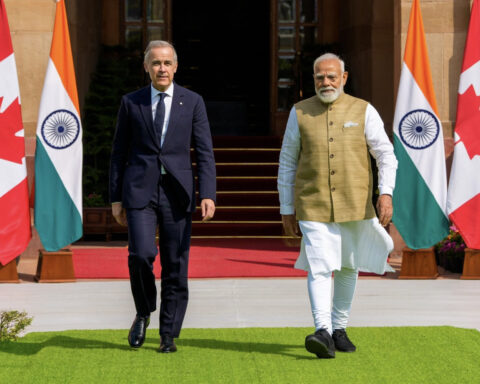

Relations between Canada and India have been a see-saw for decades, reaching a low point in 2023 when then prime minister Justin Trudeau accused New Delhi of playing a role in the killing of a Canadian national. However, things have come a full circle with Ottawa now saying that India is no longer behind clandestine activities to undermine Canada or Canadians.
RCMP Commissioner Mike Duheme said in an interview with CTV Question Period host Vassy Kapelos (in the specific context of India): “In the files that we have that involve transnational repression, we’re not seeing any connection right now with any foreign entity, based on the criminal information, the investigations that we have presently.”
What are Canadians to make of this about-turn? We asked our reporters from the Indian diaspora in Canada to weigh in on this question:
In your informed opinion, do Canadians have clarity around the issue of foreign interference by the Indian government in Canada?
“Sikh Canadians will be watching closely”
Suneet Gill, from Vancouver, B.C., specializing in community reporting:
For many, tracking Canada’s position on Indian foreign interference has been confusing. Canadians went from having a prime minister accuse Indian government agents of carrying out a policy of transnational repression against Sikhs, to having a prime minister from the same party broker a $2.6 billion deal with that very government. Amid extortions affecting South Asian business owners in the Lower Mainland — and across Canada — I believe Sikh Canadians will be closely watching how Prime Minister Carney broaches this subject moving forward, while also advancing his plans of diversifying trade relationships.
“Ottawa has not explained that clearly enough”
Shilpashree Jagannathan, a Hamilton, Ontario, journalist covering diaspora and public affairs:
Canadians still do not have full clarity, and the timing of these statements raises questions. Prime Minister Mark Carney is openly pursuing a reset with India as part of a broader push to diversify Canada’s trade and deepen strategic partnerships. In that context, when official language around foreign interference appears to soften, people will naturally ask whether the shift reflects new evidence, a higher criminal threshold, or the pressures of diplomacy and trade. Ottawa has not explained that clearly enough.
“Canada has no other option”
Vrunda Bhatt, Barrie, Ontario, storyteller and a supermom to a toddler, balancing headlines and nap times:
Canada already has a strained relationship with China, a major superpower and a major influence in the East. The country had no other option but to put the ongoing investigation against India on the back burner, mend the damaged relationship with India, and not strain it further, given India’s next-biggest influence in the Asian subcontinent. Recently, an Indian multinational just invested $300 billion in Texas to set up a refinery. Imagine what such massive investments could do for a country like Canada.
“Canadians don’t generally understand both sides of the issue”
Pradip Rodrigues, Mississauga, Ontario-based former editor of CanIndia newspaper:
The mainstream media in Canada has largely coalesced around the “underdog’s” narrative which in this case are Khalistani separatists who’ve experienced the wrath of alleged Indian agents targeting leaders of the movement. Similarly, Indian media frames this as foreign interference in their country and perceives Canada as being a haven for a movement seen as a threat. Canadians don’t generally understand both sides of the issue. Why is there “foreign interference” in the first place? For example, if Quebec and Alberta separatists set up an HQ in, say, Oregon, USA, and fomented unrest in Canada, would CSIS be monitoring these groups attempting to neutralize these threats?
How would Canadians then view the actions of our agencies?
It’s a complex issue which is not presented in totality in Canada. Unfortunately, politics and vote banks have created a situation where one community is now seen as pitted against other Indians. Canadians are confused. For many, all south Asians are brown and in one category; the infighting does not help.
Navigating intricate security and geopolitical interests
Deepan Dasgupta, Saskatoon, Saskatchewan, Communications and Media Professional:
Canada’s evolving stance on Indian ‘interference’ underscores a deep-seated ambiguity. While late 1800s migration shaped Canada’s perception about India, the masses must recognize its complex socio-political realities today. Paradoxically, Canada’s open policies have inadvertently provided a haven for anti-India sovereignty movements. This has prompted assertive Indian responses, akin to historic security precedents. Ottawa must look beyond the lens of asylum and embrace positive diplomacy to navigate these intricate security and geopolitical interests.
Questions about timing and possible political motives
Arpan Chahal from Mississauga, Ontario – Public Affairs Producer at a South Asian radio station:
There’s no doubt that most countries, to some extent, influence the policies and politics of others, with the U.S. being a clear example. During Trudeau’s leadership, bold statements, such as allegations about India’s involvement in the killing of Hardeep Singh Nijjar were made without fully shared evidence. As Prime Minister Mark Carney was about to visit India, the renewed foreign interference discussion resurfaced. This raises questions about timing and possible political motives.
(The comments provided by NCM journalists have been lightly edited for clarity and brevity)

NewCanadianMedia.ca is Canada’s premier web site dedicated to news and views about the one-fifth of Canadians who are immigrants. You’ll find original journalism from an immigrant perspective along with content produced by our partners in Canada’s ethnic media. Our content provides fresh insights into developments in politics and society, enhancing your understanding of our diverse world.