
On a clear Arpil evening, I arrived at Volvo Cars Hamilton in my gas-powered Ford Bronco Sport to test-drive a car that, at first glance, seemed to sit in the middle of Canada’s electric vehicle dilemma.
The car waiting for me was a black Volvo EX30 Ultra Twin Motor, a compact electric SUV with a minimalist front end, narrow headlights, and overall smaller and more upright than the vehicle I had driven in. If my Bronco Sport was a sturdy SUV built for North American roads, the EX30 felt quiet, quick, and designed around the idea that electric cars could turn into everyday vehicles.
On the road, the contrast was immediate. The cabin was silent, the acceleration came quickly, and the car moved smoothly over Hamilton’s spring potholes. The sales representative pointed to a speckled trim for the interiors that looked to me like chipped marble or terrazzo. Volvo calls it Particle décor, made from recycled plastic waste such as discarded PVC window frames and roller shutters—a small design detail that’s also part of the car’s environmental pitch.
The idea behind taking the car for a spin was to see what the experience of driving a China-linked EV in Canada would be like. But the EX30 turned out to be more complicated than that. Volvo is a Swedish brand owned by China’s Geely. The EX30 was initially built in China, but Volvo says current Canadian-market EX30s are assembled in Ghent, Belgium. A spokesperson for Volvo Cars later said by email that Volvo no longer has Chinese-produced EX30s in its Canadian stock, though a handful may remain on dealer lots.
That made the EX30 less a clean example of a Chinese EV than an illustration of why the category is becoming harder to define.
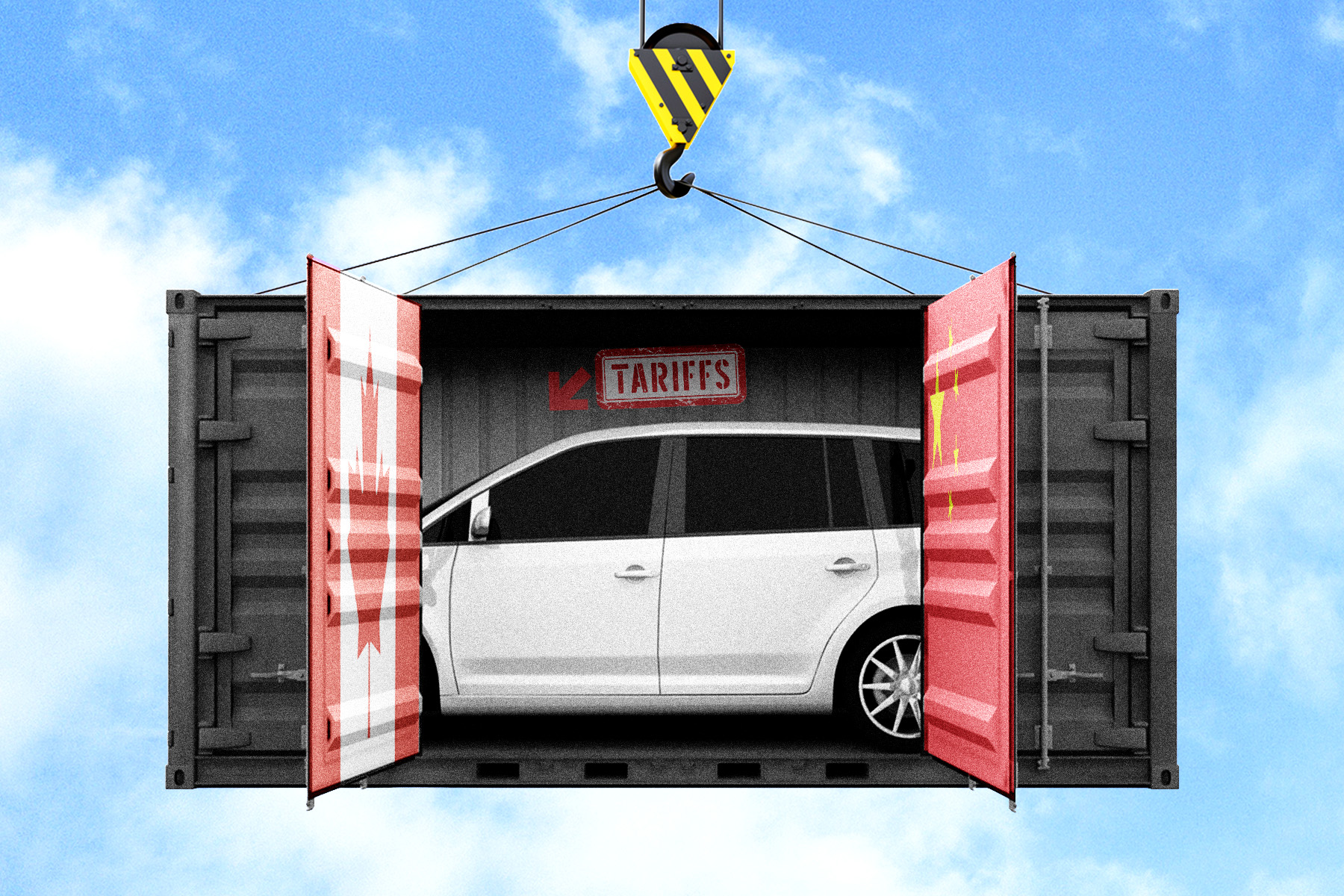
And that distinction matters. In 2024, Ottawa followed Washington’s lead and imposed a 100 percent surtax on Chinese-made EVs. That surtax meant an importer would pay an extra amount equal to the declared value of the vehicle, on top of the existing import duty—effectively doubling the tariff burden before the car reached a showroom. But this January, during Prime Minister Mark Carney’s visit to China, Canada announced a new strategic partnership with Beijing that included an opening for Chinese EVs. Canada will allow up to 49,000 Chinese-made EVs a year to enter the country at a low tariff rate of 6.1 percent, without the 100 percent surtax, with the quota coming into effect on March 1.
In a Canadian market that sold nearly 2 million new vehicles in 2025, 49,000 might seem like a small number. But globally, the shift is well underway: the International Energy Agency expected more than one in four cars sold worldwide in 2025 to be electric. And in Canada, 2026 is being called the EV “comeback” year, with Statistics Canada reporting that zero-emission vehicle sales rose 74.7 percent year over year in March, reaching 12.2 percent of all new vehicle sales.
So, at 49,000, the number is still large enough to test a few questions: Can the country protect auto jobs and make room for lower-cost EVs in a market where price remains one of the biggest barriers to going electric? What happens when Canada tries to make EVs more affordable before the market around them—rebates, charging, repairs, insurance, financing, and industrial policy—is fully settled? In essence, what lies beyond the geopolitical spectacle of Carney’s deal making in China to diversify Canada’s United States–anchored auto policy?
Rachel Doran, executive director of Clean Energy Canada, a climate and energy think tank based at Simon Fraser University, says the global EV market is moving much faster than Canada’s. EVs can be cheaper to run because electricity costs less than gasoline, but the problem in Canada is the upfront price.
Doran says there has been a real affordability gap. “People, and particularly younger Canadians, are interested in adopting electric vehicles, but the price has to be right,” she adds.

That is where she sees Chinese EVs playing a role: not as the whole answer, and not as a reason to abandon Canadian manufacturing, but as a force that could push automakers to compete harder on price. In Europe, Doran says, the arrival of some Chinese EVs helped bring down price points as other automakers introduced lower-cost models.
The EX30 showed that kind of pressure at work. The previous Canadian suggested retail price for the 2026 EX30 Ultra was $55,800 for the single-motor version and $58,800 for the twin-motor version. Volvo Cars has since repositioned the price to $49,000—a change the company said was made in response to EVAP. EVAP, short for the Electric Vehicle Affordability Program, is Ottawa’s new federal rebate program for EVs. For most imports, the final transaction value must be $50,000 or less, and the vehicle must be assembled in Canada or in a country that has a free trade agreement with Canada.
The EVAP rules have also pushed some other automakers to lower sticker prices or offer manufacturer-backed discounts so vehicles fall under the $50,000 cap. Still, not all Chinese-linked EVs are cheap. And not all of them are trying to solve the same affordability problem.
Some, like the lower-cost carmaker BYD, target mass-market buyers. But there’s also the Lotus Eletre, an all-electric luxury performance SUV with a starting price of $119,900.
Adam Thorn, transportation director at the Pembina Institute, a Canadian clean-energy policy think tank, sees Canada’s China EV opening as a “cautious first step”—useful but not enough on its own. To increase EV adoption, he says, Canada needs a “holistic ecosystem” approach, with purchase incentives, charging infrastructure, emissions rules, and domestic manufacturing policy working together.
One of the most important pieces, Thorn says, is Ottawa’s promised shift toward stronger vehicle greenhouse gas emissions standards for model years 2027 to 2032. The standards are meant to be technology neutral, allowing automakers to comply through more efficient gas vehicles, plug-in hybrids, or battery EVs (plug-in hybrids can drive short distances on electricity before switching to a gasoline-powered engine, while battery EVs run entirely on electricity). If regulations are, in fact, designed correctly and the standards tighten, Thorn says, battery electric vehicles become the clearest path to compliance.
Charging companies, Thorn says, need enough EVs on the road to make public chargers profitable. Drivers need the confidence that charging infrastructure will be available before they buy an EV. It’s up to the government to make sure both pieces move together—otherwise, in effect, Canada risks asking consumers to make the switch before the system around them feels ready.
The China EV deal, Thorn says, is only one part of a larger test. Cheaper imports may help with price; rebates may help at the dealership. But if Canada wants EV adoption to grow, the policy pieces have to line up.
If Chinese automakers want to sell into Canada, the next question, Thorn says, is whether Canada can require or encourage some of that production to happen here. That may be the most important part of the deal in the long run. Importing a limited number of Chinese-made EVs is one thing; using that opening to build new manufacturing relationships is much harder.

For Thorn, the biggest misconception is that a small number of Chinese-made EVs are the central threat to Canadian auto jobs. Thorn’s point is backed by federal figures: in 2024, Canada produced about 1.3 million light-duty vehicles, and about 1.1 million of them were exported to the US. Tariffs, trade barriers, and uncertainty south of the border are already putting pressure on Canadian plants, shifts, and jobs. In that context, he argues, the China EV opening is less of a direct threat than a sign that Canada may need to diversify its auto strategy.
“The real threat to Canada’s automotive manufacturing is US policy,” he says.
For decades, Canada’s auto sector has been organized around a North American model dominated by the US. It has supported jobs but also left Canada exposed when US policy changed. The China EV opening raises a different possibility: that Canada may need to treat Chinese automakers not only as competitors but as companies reshaping the global industry.
Greig Mordue, an associate professor in the faculty of engineering at McMaster University, says China is no longer just catching up in the auto sector. “The Chinese automotive industry is without question the world’s leader,” he says. “There will be some that say, no, no, no, it’s in North America, but the reality is that ship sailed a while ago now.”
The risk, Mordue says, is that Canada stays too tightly tethered to a US-centred auto strategy at a time when the global EV market is moving elsewhere. The opportunity is that the limited opening in the form of 49,000 EVs could give Canada a way to learn from Chinese EV production without abandoning its own manufacturing base.
Mordue does not see the 49,000-vehicle quota as a major direct threat to Canadian production. Most vehicles built in Canada are exported, overwhelmingly to the US, so what Canadians buy at home is not the same as what determines Canadian factory output. A small number of imported Chinese EVs, he says, may displace some Canadian-made sales, but not enough to remake the industry on its own.
Charlotte Yates, president of the Automotive Policy Research Centre and professor of political science at the University of Guelph, sees the opening as both a consumer move and a geopolitical one. Chinese EVs may give Canadians access to cheaper EVs, she says, but Canada still needs an auto industry that can build for the market the world is moving toward.
“I do not think there is a future automobile industry in Canada without building automotive EVs here,” Yates says. The next stage cannot be only about imports. Canada has to find ways to attract EV production, whether through existing automakers, a new automaker, or partnerships involving Canadian firms and foreign manufacturers.
Yates says any new Chinese-linked production in Canada would need clear guardrails: Canadian labour standards, unionized facilities, protections around technology transfer, and enough production volume to justify public investment. That is why assembly matters. The Canadian Vehicle Manufacturers’ Association says the sector has a seven-to-nine-to-one job multiplier, meaning each job in a vehicle assembly plant can support roughly seven to nine additional jobs in the wider economy, from parts suppliers and logistics companies to tooling, maintenance, and professional services—“the highest of any manufacturing sector.” Federal data shows the auto industry directly employed more than 125,000 people and indirectly supported about 427,000 more in 2024.
The success of Carney’s much-touted deal, then, will eventually come down to these nuts and bolts: whether Canada can put an industrial policy in place to make EVs feel practical, affordable, and supported in everyday life.
Editor’s note: This story was originally published by The Walrus and is being reprinted here with permission.

Shilpashree Jagannathan is a Hamilton-based freelance journalist and editor whose work has appeared in CBC News, New Canadian Media, The Margin, Business Insider, TRT World and Mint, and has been republished by The Walrus. She reports on immigration, labour, affordability, housing, elections, climate impacts and social justice, focusing on how policy and power shape the lives of households, workers, newcomers and local communities. Drawing on more than a decade in business journalism in India and a strong background in investigations, research and editorial work, she brings rigour and empathy to stories that trace the gap between policy and lived experience. She has also appeared on podcasts and radio programs to discuss her reporting and its broader public-policy implications.