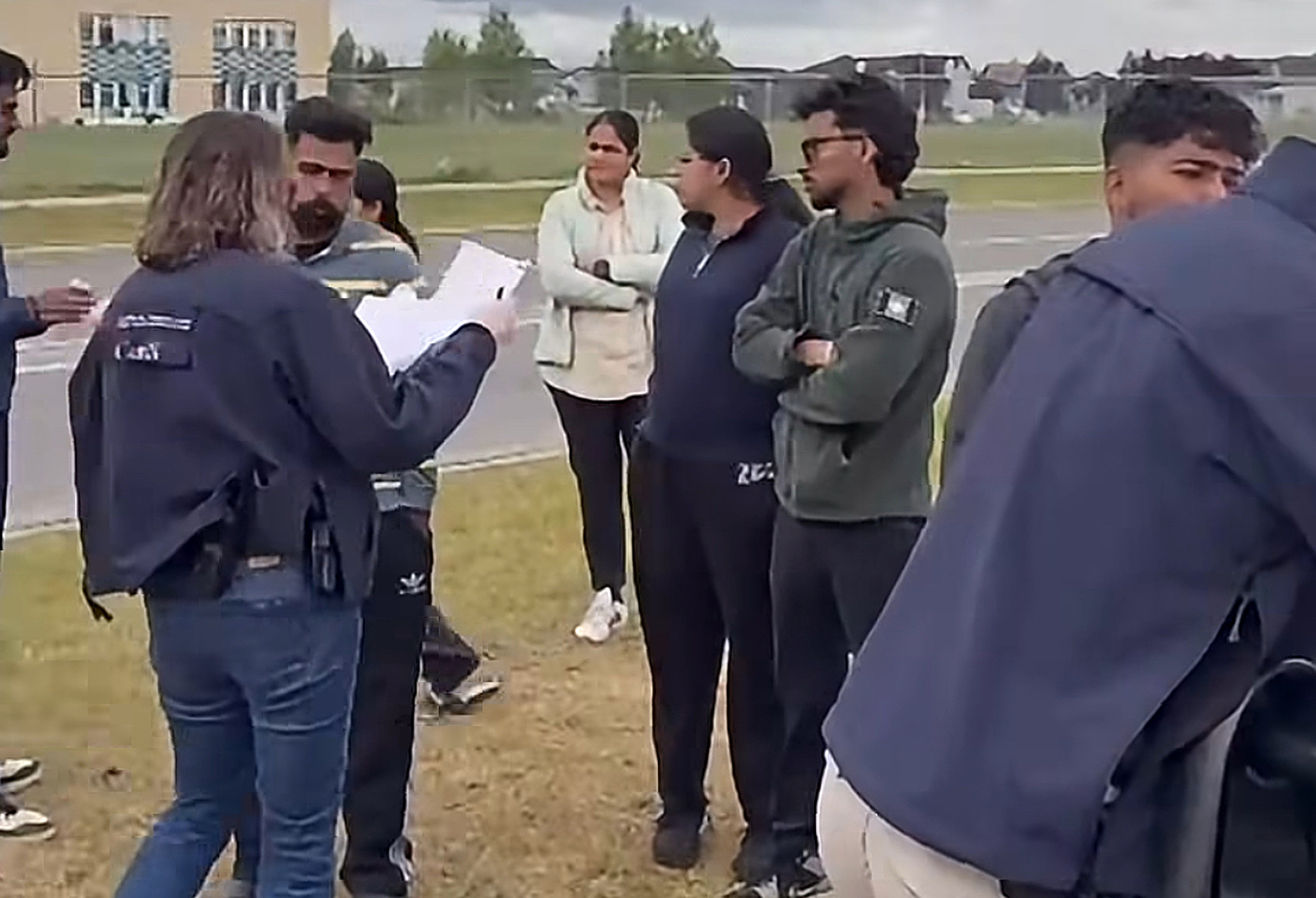

International students at a community college in Alberta and immigration lawyers are raising the alarm about the presence of border enforcement officers at a recent Calgary protest.
Bikramjit Singh of the Naujawan Support Network, an international student advocacy organization, says that the recent Canada Border Services Agency, CBSA raid on the Calgary student protest at Saddletowne Circle belies the constitutional right to protest peacefully in Canada.
Joycna Kang, a director at Canadian Immigration Lawyers’ Association and adjunct professor at the University of Toronto, also echoed a similar sentiment, calling the CBSA action “surprising.”
She said the agency’s enforcement powers are limited by statute to specific land, sea and air border points and customs posts. “However, these powers to conduct immigration enforcement does not extend to anywhere in the country they wish. Given the letter of the law, it is surprising,” Kang said in an email statement to New Canadian Media.
Kang is also alarmed by what she sees as the negative public reaction to the student protest, “with many leaning into anti-immigrant and specifically anti-South Asian sentiment to justify this breach of authority.”
The students of Portage College have been protesting a denial of Post-Graduate Work Permits (PGWPs) that would have allowed them to stay in Canada after the completion of their studies.
The students and their advocates allege the immigration rules have been applied unevenly, with some earlier PGWP applicants from the same college programs being successful. At issue is “non-credit” college programs that these students took when they secured study permits, further charging that the federal government changed the rules suddenly on June 24.
The college itself has lent credence to this charge, confirming in a web post yesterday that they were “surprised” by the denial of work permits.
The government’s defence
Both Immigration, Refugees and Citizenship Canada (IRCC) and the CBSA contradicted the students’ allegations, asserting that there have been no changes to the rules and that CBSA officers were within their rights to show up at the student protest to verify the visa status of agitators.
Rebecca Purdy, a senior spokesperson at CBSA, told NCM in an email statement that the agency typically acts on referrals from law enforcement when a person’s immigration status is unclear or when there’s an existing warrant against them. In this case, Calgary Police Service asked CBSA to check the status of four individuals at a August 12 protest.
In total, CBSA verified the status of 20 individuals at the protest. Of those, 12 were identified as “possibly inadmissible” (without a valid visa) under the Immigration and Refugee Protection Act (IRPA) and were asked to attend a CBSA office later that day for follow-up interviews. Purdy said the agency could not share further details on the individual cases due to privacy legislation.
“Foreign nationals admitted into Canada are not able to work or study unless authorized and are expected to depart Canada at the end of their authorized period of stay. When the CBSA becomes aware of foreign nationals who may be inadmissible to Canada, CBSA officers will investigate and take appropriate action,” says Purdy.
In response, Kang raised concerns around the right to protest.
“It’s certainly concerning, particularly given that it was local police monitoring the protest that called CBSA officers to come check the protesters’ statuses. This incident creates an implicit threat that a person’s right to protest is only protected if their status in Canada is stable, and that participation in any protest could lead to immigration enforcement action against you,” said Kang in her statement.
The immigration department said there have been no revisions to the rules governing work permits to foreign students pursuing non-credit courses. “The update to the PGWP webpage in June 2026 clarified guidance on existing requirements and how they apply to non-credit programs of study. This was done in response to client and stakeholder feedback, and did not introduce a new eligibility requirement. The refusals in question relate to the longstanding requirement that an eligible program of study lead to a degree, diploma or certificate and not a general interest, ESL/FSL or non-credit-earning programs.”
The spokesperson encouraged affected students to pursue other work permit options such as the Temporary Foreign Worker Program or the International Mobility Program.
Student grievances
According to the student advocacy organization, IRCC updated its PGWP webpage in June 2026, when it added the criteria that those from non-credit programs, except flying school, were ineligible for the work permits.
According to Singh, around 1,000 students who had enrolled in Portage College, a private-public partnership institution, were refused their post-graduate work permits on the grounds that their courses were “non-credit”, i.e., they did not count towards academic credits, and were therefore ineligible for PGWPs. The student protest began around three weeks ago and it was covered primarily by Punjabi-language news media.
The new rule around credit requirements came into effect after the students were enrolled in the program, and according to Singh, some students had graduated by then and have been waiting for their work permits for two years. Earlier this year, Portage students started getting “mass refusals.”
Portage College is currently seeking answers from IRCC, according to a CBC report.
Portage College updated their website on Tuesday, confirming that some of its former international students had indeed secured work permits. “We are surprised by the recent IRCC rejections of PGWP applications and we will continue to do all we can to assist our graduates as they seek work permits in Canada,” the statement read.
Both Prime Minister Mark Carney and Alberta Premier Danielle Smith have been asked questions relating to Portage College.
Carney deferred to Premier Danielle Smith answer, who said she won’t classify Portage College as a diploma mill but it might have overstated the path to permanent residency.
“Our view is that if you come here as an international student and your visa expires and you don’t have permanent residency, you have to go home,” answered Smith.
She once again asked for more control over immigration, stating that Alberta only has 6,400 spots and they have 40,000 permanent resident applicants, whereas Quebec is able to choose 45,000 of their permanent residents.

Aadya Arora is a Vancouver-based journalist interested in covering immigration, labour and women's stories as well as exploring Canadian nation-building practices.