
Artificial intelligence tools currently on the market to help immigrants navigate job searches are far too inadequate for the challenges facing newcomers, a new study has found.
Academic researchers undertook a year-long study to assess the usefulness of these AI-enabled tools. They found that AI tools, though useful for entry-level job seekers, do not reflect the real barriers new immigrants face when entering the job market. AI tools were primarily designed for practical tasks like job searching, resume building, and interview preparation.
Labour market integration for immigrants, on the other hand, requires navigating complex issues such as licensing requirements, weak professional networks, and unequal access to opportunities, which remain unaccounted for in these AI tools. The researchers are pushing for more “human-centered technology” – as opposed to efficiency-focused tools – which they say can be achieved through greater collaboration with developers, settlement practitioners, and immigrant communities.
“Advancing technology alone cannot fully address systemic barriers facing skilled immigrants,” the researcher said in email comments to NCM.
The Government of Canada cautions hiring managers that “AI can overlook cultural nuances” and suggests working with diversity and inclusion specialists as part of the hiring process. The use of AI has become common practice on both sides of the hiring process. It is being used actively to screen applicants by searching for key terms in resumes to help optimize the hiring process.
| AI App | Built for Immigrants? | Key Features | Why It Helps Newcomers |
| FillaRole | Partially (supports international talent) | AI screening, job posting, immigration compliance, LMIA support | Helps newcomers find employers open to hiring foreign workers |
| Navigrant | Yes — immigrant‑focused | AI job matching, resume builder, interview coach | End‑to‑end support for newcomers navigating a new job market |
| CareerScout | Yes — built for immigrants in Canada | TEER/NOC job matching, AI resume tailoring, Canadian cover letters | Helps newcomers target PR‑eligible jobs and adapt to Canadian hiring norms |
Credit: Table generated by Microsoft’s AI-powered assistant, Copilot
The researchers – a university professor and two immigrant settlement experts – observed that AI tools fail to take into account broader aspects of immigrant labour market integration like recognizing transferable skills and non-linear career trajectories. The researchers also emphasize the need for sustainable funding models to update older models, maintain them and make them more realistic.
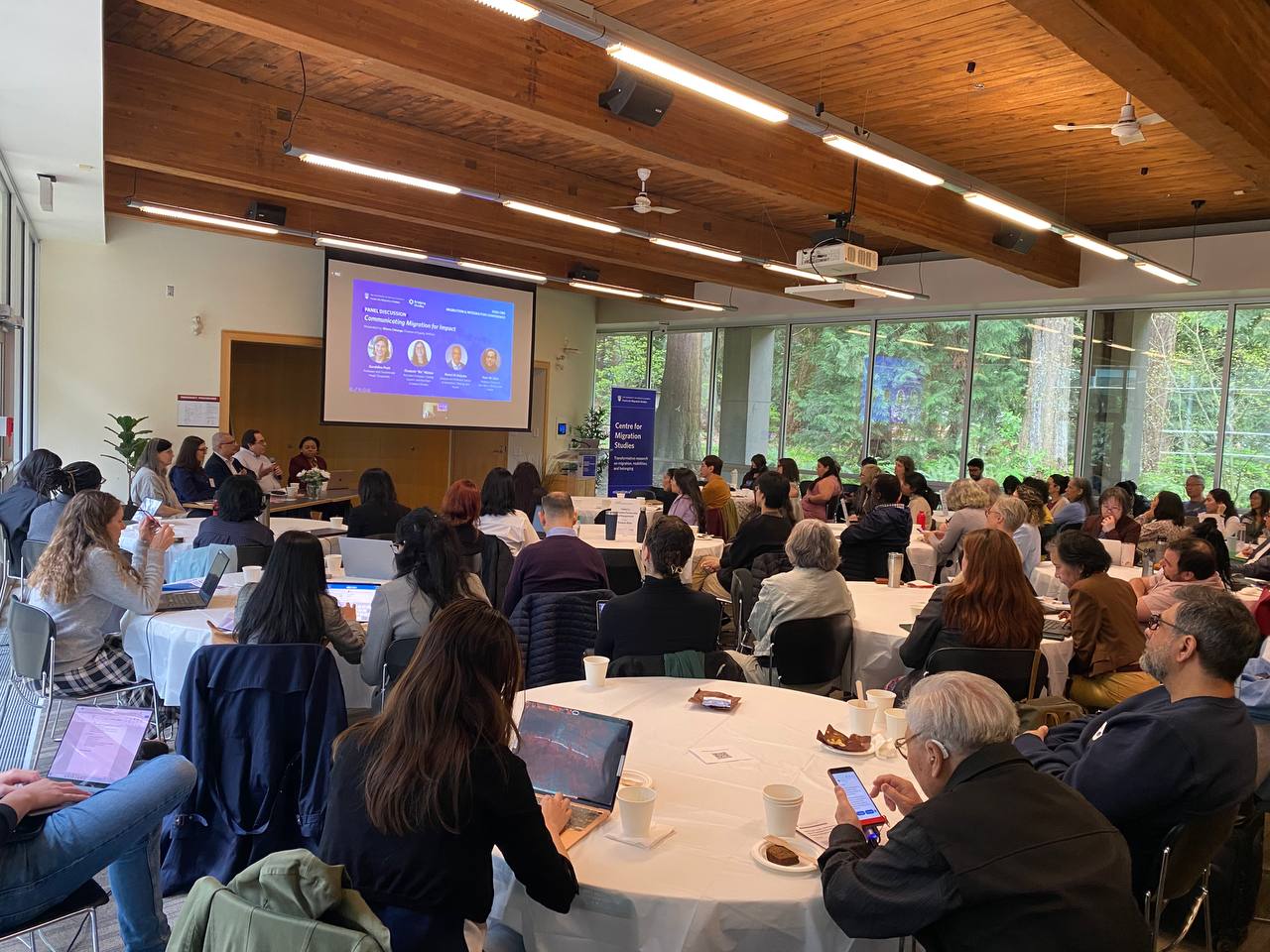
This study was part of one of the five panels presented at a migration and integration conference at UBC on April 27.
This study was titled “Evaluating the Effectiveness of Advanced Digital Technologies to Support Immigrant Professionals’ Integration into the Canadian Labour Market.” and was led by Dr. Anusha Kassan, UBC associate professor of Educational and Counselling Psychology, and presented by Fatemeh Kazemi, senior researcher at the Centre for Immigrant Research at The Immigrant Education Society (TIES) and Kreisa Hilaro, manager at TIES Centre for Immigrant Research.
“Based on our experience working in the sector, we are already seeing growing gaps in service capacity and support accessibility,” the team said. “This is especially concerning because newcomers often rely heavily on these services during their first years in Canada.”
Studying integration and identity
The conference also explored questions of identity, integration, and political behaviour. Aodi Cheng, an MA student in political science at UBC, examined how digital platforms and information environments shape attitudes toward immigration and integration among Chinese Canadians. Maxime Coulombe, Affiliate Assistant Professor at Concordia University, studied public opinion on government use of artificial intelligence, focusing on support, bias, and political behaviour using survey and experimental methods.
Irene Bloemraad, one of the conference organizers, told NCM that this year’s conference focused on impact beyond academic circles. She said migration scholars have long tried to inform public debate with evidence, but a gap still exists between university research and broader public understanding.
Bloemraad also said that researchers are increasingly using technology in their work. Several projects went beyond traditional methods, using tools such as AI-generated images and interactive storytelling in outdoor spaces, to explore how people make sense of complex issues like artificial intelligence and the sense of belonging.

Diary Marif is a Vancouver-based Kurdish writer and award-winning journalist born in Iraq. He holds a master’s degree in history from Pune University in India (2013). His journalism has appeared in national and international outlets, including Rabble, Canadian Dimension, CBC Arts, Culturico, The Amargi, and The Canadian Encyclopedia. Since 2018, Marif has centred his creative work on memoir and personal narrative, exploring his experiences as a child of war. He has written chapter books for multiple projects and has appeared as a storyteller in public spaces. He received an Honourable Mention for the 2022 Susan Crean Award for Nonfiction, is a 2025 recipient of the Yosef Wosk Vancouver Manuscript Intensive Fellowship, and was awarded PEN Canada’s 2025 Marie-Ange Garrigue Prize.