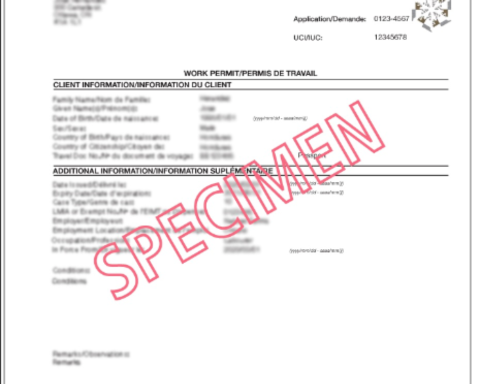

A temporary resident in B.C. is fighting the government’s decision to deny him a work permit extension under a special program for Francophone candidates on the grounds that he never lived or studied in a French-speaking country. He has had to stop working as a result of the refusal.
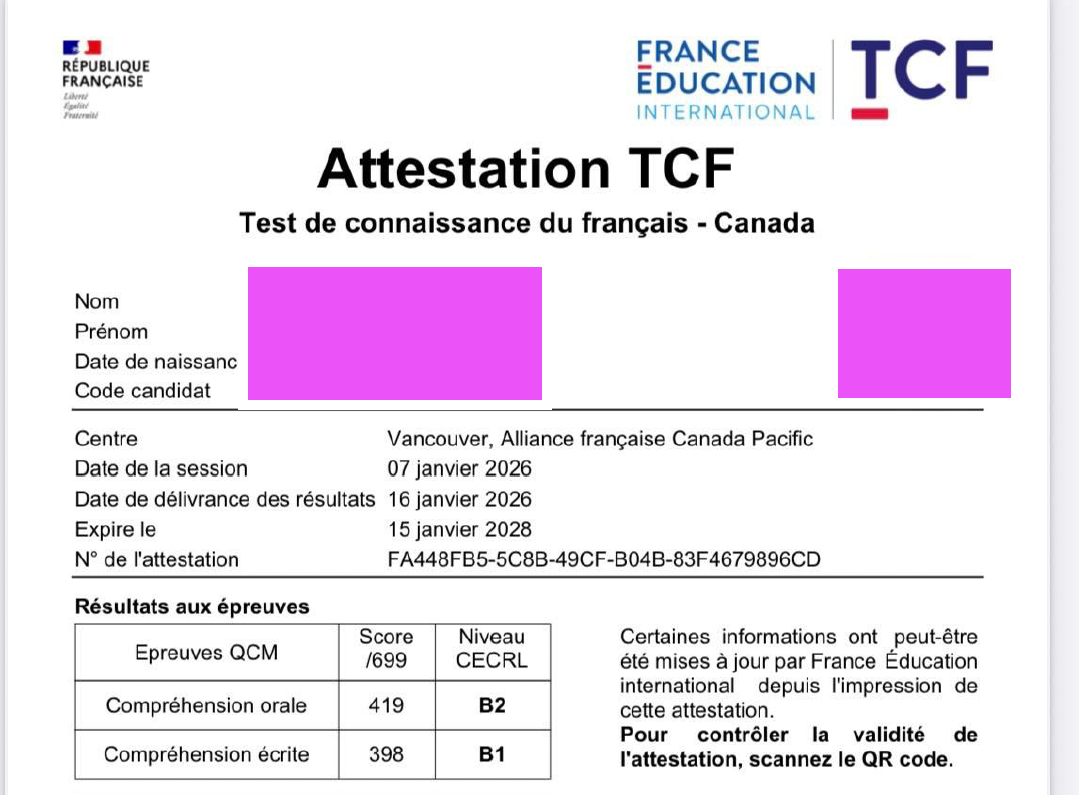
According to Sahil (NCM is protecting his identity at his request), who applied for a work permit extension under the Francophone Mobility Program, and his lawyer, Sahil passed the French listening and speaking ability skills as assessed by the Test de Connaissance du Français (TCF).
Sahil (28) finished his post-graduate diploma in 2023 at Langara College and has been working as a community coordinator at a property management company since then. He studied French for a year before applying for a work permit extension on March 24 under the special program that allows employers to hire French speakers outside of Quebec without a Labour Market Impact Assessment (LMIA). Employers obtain an LMIA to prove that a Canadian citizen or permanent resident isn’t available to take the role.
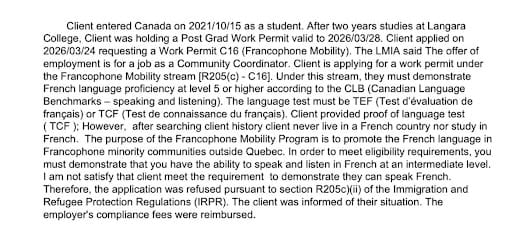
He said he received a refusal letter within two weeks on April 8 stating: “[C]lient never live [sic] in a French country or studied in French.” He has now taken Immigration, Refugees and Citizenship Canada (IRCC) to federal court. Steven Meurrens, a lawyer in Vancouver, B.C., is representing this case in federal court, hoping to get his client’s application reopened within a month.
The Francophone Mobility Program requires proof of intermediate French speaking and listening abilities, defined as the “equivalent to a level 5 or higher in the Niveaux de compétence linguistique canadiens (NCLC) scale.”
Sahil received the scores to meet the competency needed for the Francophone program. However, his rejection letter, while confirming that the candidate provided his language test results, stated the client has never lived in a French country or studied in French. As a result, he had to stop working immediately and inform his employer that he has lost his work status in Canada. Steven Meurrens, a lawyer in Vancouver, BC, is representing this case in federal court, hoping to get his client’s application reopened within a month.
“I think the [Immigration, Refugees and Citizenship Canada, IRCC] decision is wrong. IRCC set the criteria, and the person met the criteria. So we will ultimately be successful,” said Meurrens.
NCM asked IRCC about what counts as sufficient proof of French language skills and they did not mention residing in a French-speaking country as part of their criteria. French ability can be demonstrated through test scores or completion of college or university program in French, the government said.
When asked separately about how long an individual has to live in a French country to demonstrate required proficiency, IRCC replied: “Residence in a francophone country is not considered as proof by itself; documentary evidence of French ability is required.”
Muerrens commented on IRCC’s response, saying he thinks that “the decision was unreasonable based on IRCC’s own guidance.”
Applicants in limbo
Once an application under this program is rejected, the applicant has two options: either to apply for reconsideration or to take the case to federal court for a judicial review, which has to be done within 15 days if residing in Canada. IRCC is not obligated to open reconsideration emails and does not provide a timeline for an answer. Judicial review, on the other hand, can take up to three months to get a decision.
“I get that IRCC can make mistakes. The problem is that they have no process of rectifying that mistake … so basically, you will tell me [IRCC] made a mistake but I wasted 3-4 months, and you won’t even reimburse me for it,” said Sahil.
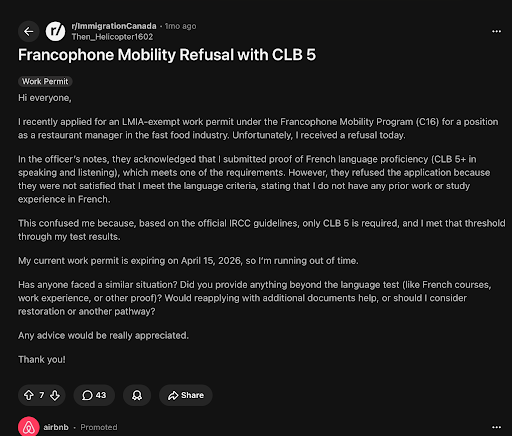
Recent posts on social media platforms indicate this may not be a standalone case, airing similar complaints.
“I think just one officer went beyond the program criteria and applied their own definition of a Francophone,” said Muerrens. “I don’t know if it’s one officer or multiple officers kind of making the same decision.”
Another immigration lawyer, Miguel Martins Pereirinha, who also practises in Vancouver, saw these posts, but hasn’t had any cases come up to him.
“There seems to be a mandate to reduce temporary resident numbers overall, and IRCC officers, it seems like there is higher scrutiny, but in certain cases, they’re going beyond what they’re allowed to decide cases on, and that’s called fettering their discretion,” said Pereirinha.
More French Learners within Canada
In June 2023, the eligibility requirements for the Francophone Mobility Program were lowered from requiring a 7 on the NCLC test to a 5.
“I think when the policy makers changed the test from CLB7 and everything to CLB5 and oral and listening, they did that knowing that it would broaden who would apply,” said Meurrens.
Daily Hive reported on March 15 that Alliance Francaise in Vancouver saw a 200 per cent increase in people taking French exams for PR at their centre. The Ottawa branch saw a 245 per cent increase and the Calgary branch saw a 51 per cent increase. While a considerable number of people have started learning French with hopes to fulfill requirements for either the Francophone Mobility Program or to get a higher Comprehensive Ranking System (CRS) score to secure permanent residency (PR) via Express Entry, there are doubts about how the rules are applied.
“For [IRCC] to refuse these Francophone permits despite their push for Francophone speakers, doesn’t make a whole lot of sense to me, so my only kind of conclusion is perhaps that they really weren’t expecting these many people to learn French,” said Pereirinha.
Increased financial strain on applicants
Sahil, who has been working for less than three years in Canada and is currently out of work, said it can cost between $3,000 – $12,000 to hire a lawyer to take this kind of case for judicial review. The rejection letter directly creates a financial strain on the applicant: they would either get a lawyer in hopes of fast-tracking the process or go through a three-month wait time to resolve the appeal without employment, which is especially hard given as, Pereirinha mentions, a lot of immigrants live “paycheque to paycheque.”
Meurrens also echoed how these immigration programs affect immigrants like Sahil, who now lives off his savings.
“It’s a harsh system, especially for someone like [my client] who studied here, followed all the rules, ostensibly is living in a bilingual country … is on his way to learning French, did everything right, yet could find himself unable to work. It’s a very harsh system,” said Meurrens.
Editor’s Note: A pseudonym has been used to protect the identity of the temporary resident.

Aadya Arora is a Vancouver-based journalist interested in covering immigration, labour and women's stories as well as exploring Canadian nation-building practices.