

Enticed by promises of a straightforward path to permanent residency, Sergio da Silva left his hometown of Sao Paulo, Brazil for Montreal in 2022. He had been learning French for four years and was enrolled in a master’s degree in education, an in-demand profession in Quebec.
Confident that he and his family had ticked every box required of them, da Silva was in the process of applying for the Quebec Experience Program (PEQ in French) after graduating from his studies in the summer of 2024, only for the pathway to permanent residency to be suspended in October that same year. The entire program was abolished in November 2025, leaving da Silva, whose work permit runs out in December 2027, in a state of precarity.
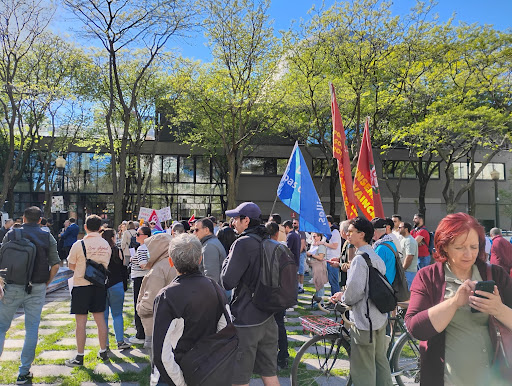
“After that [the suspension and abolishing], it was total distress in my life. I left my job a few months later because my mental health was really overwhelmed,” said da Silva while attending a May 22 protest against the government’s inaction on the PEQ organized by Le Québec c’est nous aussi (LQCNA), an activist group that advocates for immigrant rights in the province.
“It was the first time in my life that I took medication for mental health, for depression, anxiety and distress in general. We felt a lot, me and my family.”
Thousands of Quebec-based immigrants like da Silva are facing tremendous uncertainty, as they face expiring work permits and scant details over whether they will be able to stay under a renewed PEQ program that was promised by Quebec Premier Christine Fréchette months ago, but has not yet materialized. According to numbers obtained by La Presse, just over 15,000 immigrants have been admitted to the PEQ per year since 2021.
“When we left our country it was difficult to say goodbye to our family. Now we have to do all that again? We really feel abandoned.”
The PEQ was replaced in November by the Skilled Worker Selection Program (PSTQ), an invitation-only program. The new program docks points for applicants in the Montreal and Laval metropolitan areas, while awarding bonus points to those in the education, construction and healthcare sectors.
Fréchette’s Coalition Avenir Québec (CAQ) government has set an annual target of 45,000 permanent residents starting in 2026, down from 66,500 in 2025.
Fréchette recently told La Presse that she would grant a grandfather clause to 26,000 “PEQ orphans” over the course of two years, while eligible immigrants would also be able to access permanent residency through the more restrictive PSTQ program.
When asked by NCM to provide a specific timeline on the PEQ’s re-opening, a media officer at the Ministry of Immigration, Francisation and Integration (MIFI) said that Minister François Bonnardel would be releasing details “at an opportune time.” Fréchette has said that she will formally announce the PEQ’s re-opening by June 12, when the National Assembly goes on its summer break.
The minister’s office declined to answer specific questions relating to the PEQ.
The political dimension
Quebec’s October election could also have a major impact on the future of immigration in the province. Parti Québécois leader Paul St-Pierre Plamondon, who is currently leading provincial polls to become the next premier of Quebec, has been highly-critical of the government’s immigration policies. While St-Pierre Plamondon has signalled that his party is open to grandfathering PEQ orphans, he has also promised to significantly reduce immigration in the province.
Meanwhile, Parti Libéral du Québec leader Charles Milliard has also been critical of the CAQ’s handling of the PEQ program, calling on the government to reopen the program. Milliard’s party currently sits second in provincial polls.

New program’s narrower focus
Yamanda Z. (who declined to use her full name) lived in Algeria, France and Toronto, before finding a permanent home in Montreal. At least that is what she and her husband thought, before the Quebec government suddenly decided last November to abandon a program that rewarded immigrants for work experience in the province. Now, she is unsure what she’ll do when her work permit expires in September this year. Her and her husband’s steady jobs, housing and their daughter’s schooling are currently uncertain.
Yamanda Z. believes that her and her family’s circumstances make the PSTQ an unattractive option for remaining in the province.
“For the PSTQ, if you’re over 35, you lose points. If you live in Montreal, you lose points. It doesn’t make any sense,” she said.
Similarly, da Silva and his wife are concerned that due to their age (da Silva is 36, while his wife is 40) and the fact that they live in Montreal will mean they won’t qualify for the PSTQ.
“I still have a little time, but … it’s not guaranteed, because the PEQ isn’t there,” he said. “If we don’t have the PEQ, I don’t know what I’m going to do, and I’m going to have to wait until December 2027 to plan my life.”
Montreal-based immigration lawyer and co-president of the Quebec Immigration Lawyers’ Association Yves Martineau claims that Fréchette’s promises leave numerous question marks.
“The key word that comes to mind is uncertainty,” said Martineau, who works with a number of clients who have expiring work permits in the near future.
Martineau warns that Fréchette’s promises to grant a grandfather clause to ‘PEQ orphans’ while decreasing new permanent residents to Quebec is unrealistic.
“Somehow there will be restrictions on the PEQ, we just don’t know which ones,” he said. “The numbers just don’t add up.”
With such uncertainty surrounding the PEQ, Martineau has directed many of his clients to try their luck in provinces outside of Quebec, even if they moved to Canada with the intention of settling in the province. Many of his clients are well-positioned to qualify for the Francophone Mobility work permit, which promotes Francophone migration to provinces outside of Quebec.
Martineau has also noticed that many immigrants that have come through the PEQ program from Western European countries like France and Belgium are returning to their home countries after exhaustive and complicated efforts to obtain permanent residency. However, migrants from the Global South are less likely to repatriate due to a myriad of factors, such as poor economic opportunities and political turmoil, the immigration lawyer said.
Yamanda Z. is hopeful that Fréchette’s promises to re-open the program will provide an opportunity for herself and her family to stay in Montreal, but her looming September deadline is causing enormous stress. And while she moved frequently in her 20s, the 35-year-old has no intention of unsettling her young daughter, who has built a network of friends and a steady routine.
LQCNA is pressing the CAQ to implement a grandfather clause for those affected by the program’s cancellation.
“They made us a promise, now keep that promise … we do not have time [to waste],” said Yamanda Z., a member of the group. “There’s depression, there’s burnout. There are children … who have seen their parents in impossible stress for months.”
She also notes that while a grandfather clause would address many of the PEQ orphans’ short-term concerns, receiving permanent residency is still not a guarantee.
Attracted by economic opportunities and cultural tolerance, Smail Belkai moved his young family from Algeria to Quebec nearly two years ago under the PEQ program. He works at a retirement home in Granby, about an hour’s drive outside of Montreal, where he says the vast majority of his coworkers are also immigrants.
“If we stop working, what’s going to happen to the seniors? It’s a job that Canadians refuse to do,” he said.
According to Belkai, he initially signed a three-year contract with the promise of access to permanent residency after 24 months. With the PEQ’s closure, he has 18 months left on his work permit. Given the financial and time investment he and his family have made, returning to Algeria is not an option.
“I have two children, soon I will have a third,” Belkai said. “They go to school and my wife also works. I left everything in Algeria, I gave up everything. I gave up my job, I gave up my family.”
Shuang Liu moved from China five years ago, working as a cook while taking French classes. According to Liu, her boss had been looking for a cook for two years without success before she applied. Her husband’s work permit expires this year, while her own finishes in 2027. Liu is worried that if the CAQ does not re-open the PEQ, they will have to return to China.
But after living in the province for five years, Liu and her family have fallen in love with Quebec, and made plans to stay long-term. Her teenage son now plays ice hockey and speaks French with a Quebecois accent, a testament to their integration in the province’s unique culture.
“We participate in all the community activities. We have travelled everywhere in Quebec, because we love life here,” she said.
Da Silva, who is an active member of LQCNA, says that he and his family speak French at home, even if it is their second language. His wife has taken francization classes, while his two teenaged children are both in school in Montreal.
“We all learned French from scratch, we don’t even speak English,” he said.

Impact on bakeries
Among the industries hit hardest by the PEQ’s cancellation has been Quebec-based bakeries, as the program brought a large number of highly-skilled workers from Francophone regions of Europe. Many bakeries have seen key staff members return home due to expiring work permits, according to Dimitri Fraeys, Vice-president of innovation and economic affairs at the Conseil de la transformation alimentaire du Québec.
He says that employers were able to rely on the PEQ due to its path for permanent residency, whereas the PSTQ is a much more targeted program that excludes bakers.
“We don’t know how they’re going to select them. We don’t know how many they’re going to select,” said Fraeys. “That’s the big unknown. We don’t know very well yet how this new program works. And we know that the government has put priorities on health workers, on education workers. Perfect. But in food, the needs are there. And those who are already well integrated, we would like to be able to keep them.”

Seth Forward
Seth Forward is a Montreal-based journalist who has appeared in the Vancouver Sun, The Globe and Mail and other publications. He has a keen interest in Canadian immigration and immigrant communities, and has reported out of B.C., Ontario and now Quebec. In his spare time, he enjoys playing soccer and exploring the outdoors.