


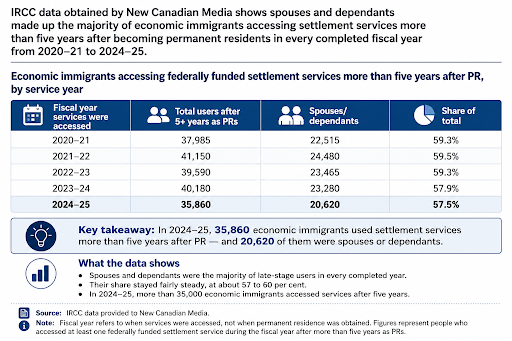
More than 35,000 economic immigrants accessed federally funded settlement services after becoming permanent residents in 2024–25, according to previously unpublished data provided by Immigration, Refugees and Citizenship Canada to New Canadian Media.
Those seeking support will now have less time to get help.
Of the 35,860 people who used at least one service that year, 20,620 — or about 57.5 per cent — were spouses or dependants.
The figures put numbers behind concerns raised after Ottawa introduced a time limit on federally funded settlement services for economic-class permanent residents. Since April 1, 2026, they have been eligible for services for up to six years after obtaining permanent residence. The window will narrow to five years on April 1, 2027.
The limits apply to principal applicants as well as accompanying spouses and dependants.
New Canadian Media previously reported that IRCC’s Gender-based Analysis Plus found the change could have a “slightly greater impact” on spouses and dependants. Women make up a majority of clients using several settlement supports, including language training and childcare services.
The new data show spouses and dependants were the majority of economic immigrants accessing services after five years starting in each fiscal year for which data was provided. Their share of the overall support received ranged from about 57 to 60 per cent between 2020–21 and 2024–25.
IRCC said settlement-service use generally declines as newcomers become more established. About six per cent of economic immigrants access services five or more years after becoming permanent residents, the department said.
Data shows recurring needs
This represented tens of thousands of people annually. The total reached 41,150 in 2021–22 and stood at 40,180 in 2023–24 before falling to 35,860 in 2024–25.
IRCC cautioned that the figures count people who accessed at least one service during a fiscal year, not people who necessarily used services continuously. Someone included in the 2021–22 total, for example, was not necessarily still accessing services in 2024–25.
Information and orientation service that includes guidance on life in Canada, such as navigating health care, schools, housing, government services, legal information, financial basics and referrals to other settlement or community supports was the most commonly used service beyond the five-year mark in 2024–25, with 28,325 users. Needs assessments and referrals were accessed by 15,000 people, followed by community connections, language training, language assessment and employment-related services.
People can appear under more than one service category, so the service figures cannot be added together to calculate a client total.
Kim Jenkinson, executive director of HMC Connections, said the economic immigrants most likely to need settlement support after five years are often those facing additional vulnerabilities, including limited English, interrupted income or family instability.
Economic principal applicants may already be working, she said, while their spouses, children or other family members often access services later.
Families typically focus first on getting the principal applicant established in the labour market, Jenkinson said. But circumstances can change through job loss, family breakup or other interruptions to the settlement process.
“If there’s family breakup or employment interruptions, newcomers are particularly vulnerable,” she said.
People with limited English may also remain disconnected from their communities and experience greater social isolation, she said. They may still require language support, community connections and help preparing for citizenship.
Jenkinson said a fixed deadline could leave some clients looking for private, for-profit help or without comparable support. She suggested Ottawa consider exceptions for people who can demonstrate an ongoing need.
“Maybe there could be an exception-based system,” she said. “Certainly there should be exceptions made where people still need support.”
John Shields, professor emeritus of politics and public administration at Toronto Metropolitan University, said settlement support should not be determined based on a uniform deadline.
“We need to look at services on the basis of what is the need — to be needs-based,” he said.
Shields said members of an immigrant family do not necessarily follow the same settlement timeline. In many economic-immigrant households, the principal applicant’s career is prioritized first, while the accompanying spouse — often a woman — takes immediately available work, manages caregiving or postpones language and employment support.
“Oftentimes there’s a strong gender effect,” he said.
That can mean the spouse’s need for language training, credential guidance or employment services emerges several years after the family becomes permanent residents.
Shields also questioned whether settlement funding and eligibility rules account for immigrants who arrived during earlier years of higher admissions.
“The way that they calculate what the funds are needed for is out of sync with how settlement actually works,” he said. “It’s just not a one-year thing.”

IRCC says limiting eligibility encourages economic immigrants to use services earlier and helps keep the program sustainable and available to newcomers who need it most. It has also said clients generally experience the strongest settlement outcomes when they use services within the first 6 to 12 months after admission.
The dataset does not show how many people accessed services between their fifth and sixth anniversaries of permanent residence, compared with those who had held permanent residence for longer. That breakdown would be needed to measure the immediate effect of the current six-year limit.
But beginning in April 2027, economic-class permanent residents who have passed the five-year mark will fall outside the federal eligibility window.
For Shields, the change is part of a broader shift toward placing more responsibility on immigrants and community organizations.
“The warmth of the Canadian welcome, in terms of settlement services, has gotten a little cooler.”

Shilpashree Jagannathan is a Hamilton-based freelance journalist and editor whose work has appeared in CBC News, New Canadian Media, The Margin, Business Insider, TRT World and Mint, and has been republished by The Walrus. She reports on immigration, labour, affordability, housing, elections, climate impacts and social justice, focusing on how policy and power shape the lives of households, workers, newcomers and local communities. Drawing on more than a decade in business journalism in India and a strong background in investigations, research and editorial work, she brings rigour and empathy to stories that trace the gap between policy and lived experience. She has also appeared on podcasts and radio programs to discuss her reporting and its broader public-policy implications.