
Canada’s immigration enforcement agency is ramping up deportations — currently sending back 400 migrants a week — and is hoping to sustain an annual target of 20,000 over the next couple of years.
These numbers come in the wake of Opposition Leader Pierre Poilievre’s assertion in a podcast interview last week where he estimates the number of people who may be overstaying their work or study permits at two million people. “[W]e don’t know how we are going to deal with their refusal to leave and what this means for housing, health care and jobs,” Poilievre told former CBC news anchor Peter Mansbridge.
This high number of migrants “without status” is not surprising given the policy change in late 2023 when Canada reversed course on admitting large numbers of international students and temporary foreign workers. In addition to deportation, they also face the prospect of being denied future visa applications.
However, the number of people in Canada without a valid visa remains guesswork.
“My sense is we really don’t know how many temporary migrants may be overstaying their visas,” according to Prof. Christopher Worswick, who is part of Carleton University’s Migration Policy Research Group.
“Given the massive increase in temporary residents over the [prime minister Justin] Trudeau years, it is a major concern, but I don’t think there is a way to know for sure if people are leaving, which is to say the least, unfortunate.”
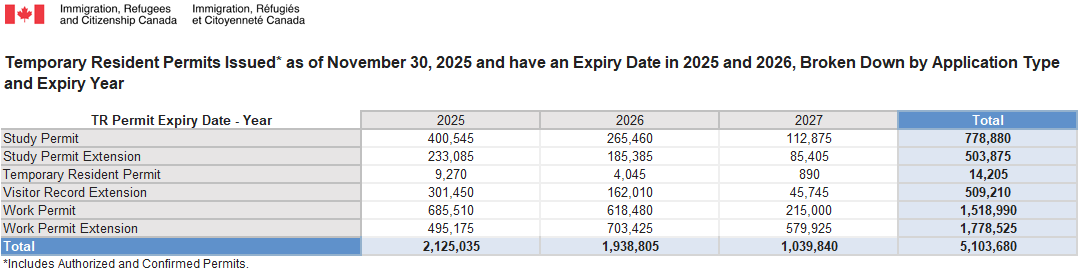
Immigration, Refugees and Citizenship Canada provided data on the number of temporary-stay visas and permits issued as of Nov. 30, 2025, covering the years 2025, 2026 and 2027, which total 5.1 million. The ministry noted that this figure may be misleading because it includes those who hold multiple visas or permits simultaneously (an international student, for example, can also have a work permit), those who may have extended or restored their status or have left Canada. Ottawa does not have a way of tracking those who leave Canada.
Canada’s ongoing immigration crackdown has its detractors, who see the country turning its back on foreigners who were brought here to “subsidize” the education system and offer cheap labour on farms and factory floors over the preceding seven years.
In the words of Syed Hussan, co-executive director of the Migrant Workers Alliance for Change: “They are denied permit renewals and permanent residency and then criminalized for working to feed their families. What is needed is equal rights and permanent resident status for all, not hunting down people who are working.”
The Canada Border Services Agency’s (CBSA) high target numbers for deportations rely on two drivers: A Border Watch Line, which specifically calls on tipsters to report (among others) “persons who have overstayed their status in Canada or who are working or studying in Canada without authorization,” and prosecuting employers for “the unauthorized hiring of foreign workers.” In the latest case, the agency has laid criminal charges against two directors and an employee of a Quebec company for hiring 21 foreign workers who were not authorized to work at the premises.
According to a CBSA spokesperson, the tip line is buzzing, receiving 47,900 tips in 2025. These included 9,400 tips specifically flagging suspected foreign nationals working illegally in Canada. The CBSA deported 22,500 foreign nationals in 2025 – the highest annual total in its history – and is currently removing approximately 400 individuals from Canada each week.
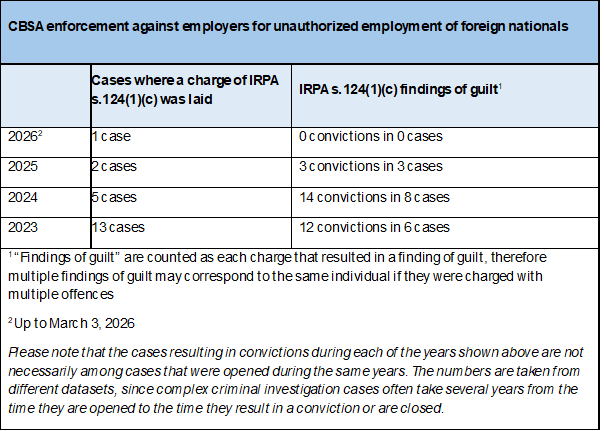
The agency has received new funding to ensure that it has the resources to enforce immigration laws, targeting about 20,000 annually over the next two years, the spokesperson said, prioritizing cases with a criminal history or national security concerns such as terrorism.
This focus on criminality is similar to the initial days of the U.S. immigration crackdown launched January 2025, which began with Immigration and Customs Enforcement (ICE) focusing on convicted criminals, drug and weapons smuggling, and human trafficking. However, ICE’s tactics have gone far beyond this stated goal, most recently on the streets of Minneapolis.
However, academics who study immigration enforcement see no parallels between the gravity of what is unfolding in many U.S. states and Canada’s newfound vigour in enforcing visa rules.

George brings 30 years of writing and newsroom management experience to New Canadian Media. He began his journalism career with The Times of India in Mumbai (formerly Bombay), followed by stints at the Khaleej Times in Dubai and as managing editor of The Peninsula in Qatar. A journalist with high ethical standards, George won the prestigious Nieman scholarship at Harvard University (1994-95), and more recently, pursued a Master’s in Journalism at Carleton University (2004).