

Editor’s note: This story has been updated to correct the title of Marshia Akbar. She is Research Area Lead on Labour Migration with the Canada Excellence Research Chair in Migration and Integration at Toronto Metropolitan University.
Abiodun Adetu, founder of Naija Markets is elated as her recent July 4 event at Winnipeg’s iconic Forks marketplace was a huge hit. She juggled countless responsibilities—from coordinating nearly 100 vendors and driving promotional efforts to overseeing every last detail behind the scenes—to ensure the lively market ran seamlessly.
“What began in Winnipeg has now expanded to more than 15 cities across Canada, bringing together entrepreneurs, artists, food vendors, performers and community organizations,” she proudly shared.
Adetu’s road to entrepreneurship began out of necessity as she was unable to find employment matching her qualifications and experience, despite her relentless efforts.
“They didn’t recognize my qualifications even though I was granted permanent residency based on my experience.”
Adetu launched her home-based market-organizing business in 2024 after leaving a high-pressure job that left her with little time for her children. When she was unable to find alternative employment, she decided to strike out on her own—marking the beginning of her entrepreneurial journey.

Canada is home to one of the world’s most highly educated immigrant populations. Despite arriving with degrees, professional credentials and years of experience, many newcomers end up in jobs that do not match their qualifications.
A 2025 report by Toronto Metropolitan University’s BMO Newcomer Workforce Integration Lab found that immigrant women continued to have lower employment and labour-force participation rates than immigrant men and Canadian-born women, with racialized immigrant women experiencing some of the widest gaps.
Nada Basir, Associate Professor of Strategic Management at the Conrad School of Entrepreneurship & Business, University of Waterloo, says her research shows recent immigrant women face unemployment rates nearly double that of Canadian-born women. “And that’s just unemployment. Many more are underemployed, working in roles far below their qualifications.”
Basir said the lack of recognition for foreign credentials and work experience remains a major barrier to employment for immigrants in Canada. Limited access to affordable childcare and the absence of the family and community support networks many relied on back home make it even more difficult for immigrant women to enter the labour market.
Marshia Akbar, Research Area Lead on Labour Migration with the Canada Excellence Research Chair in Migration and Integration at Toronto Metropolitan University, describes immigrant women starting home-based businesses as a way of reclaiming agency and self-worth, as well as a reflection of their resilience.
She explained that home-based businesses have lower startup costs by eliminating the need for commercial space, allowing women to build on existing skills without formal business training at the outset. They also offer greater work-life balance by integrating care responsibilities with income generation.
According to Statistic Canada, racialized men accounted for 27 per cent of the male self-employed population, and racialized women accounted for 23 per cent of the female self-employed population. The recent study found the self-employment rate for racialized women was somewhat similar to that of non-racialized, non-Indigenous women. However, there were notable differences among racialized groups. Korean-Canadian women had the highest rate, and Filipino and Black-Canadian women had the lowest.
Akbar cautioned that many of the home-run businesses operated by immigrant women are informal and remain unregistered, making it difficult to accurately measure their scale and economic impact. In contrast, registered businesses contribute more visibly to the economy through taxes, job creation and the production of goods and services.
“The informal or ‘underground’ economy, though under-documented, plays a significant role in wealth generation and economic survival for these families. The multidimensional contributions include not only economic output but also cultural and social capital that invigorate ethnic neighbourhoods and promote inclusivity,” she said.
Connecting Communities Through Culture, Commerce & Celebration
“We don’t have markets in Canada like we had back home. So we bring small and local businesses together under one roof. It’s full of hustle and bustle—people bargain and make deals. We’ve worked with over 100 vendors and have a long wait list,” Adetu said.
Her experience managing events back home helped her build the business. She runs it as a home-based venture, overseeing venue bookings, vendor coordination, permits, sponsorships, partnerships and digital marketing from home.
She says working in the comfort of her home has been a blessing, as she lacks the support system she used to have before coming to Canada. “The community I come from is very communal. Every Nigerian is your uncle and auntie. Here you lack family and communal support and have to look after your work and family. You have to make sure there is food on the table, kids are taken care of, cleaning is done—it is a lot of work on your own.”
The business is still scaling and remains self-funded, with most support coming from volunteers rather than full-time staff. Adetu hopes there will be more government funding for immigrant-led businesses like hers to help them grow.
Basir said that access to financing is a key gap for immigrant women. She says all women face challenges in accessing capital, but the added barriers of no Canadian credit history and smaller professional networks make it even harder for immigrant women.
Handmade in Canada
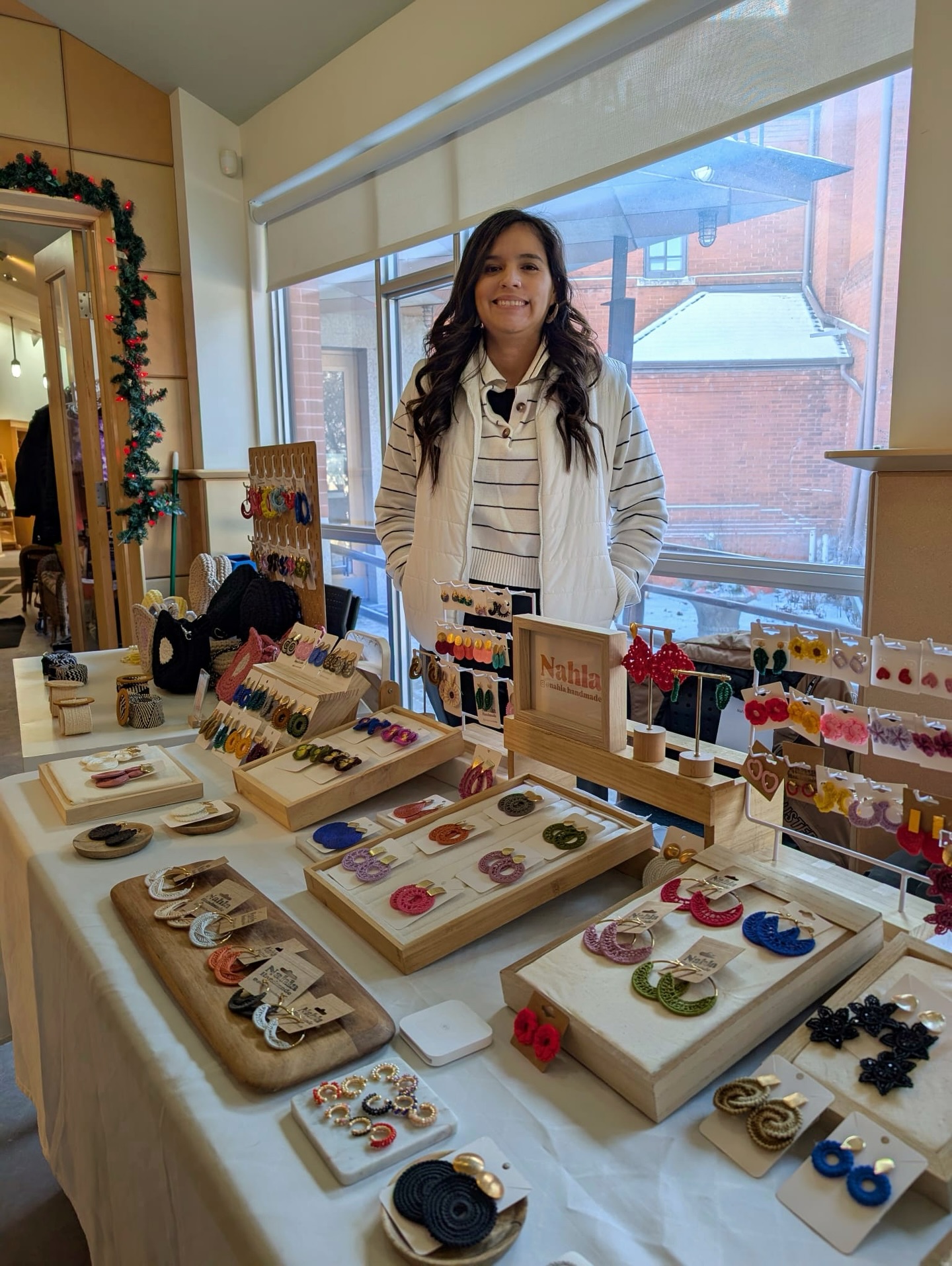
Sabrina Gomez immigrated to London, Ontario from Colombia in 2018. A graphic designer and web developer, she first worked as a server and volunteered before breaking into her field in Winnipeg. Today, she works as a web developer by day and creates jewellery in her spare time.
“Nahla Handmade is a small business I started during the COVID lockdown. It began as a hobby. I taught myself embroidery and crocheting to make jewellery like I used to get back home. I started posting it online, and it attracted attention,” she said.
Later, Gomez created a social media page and began selling her handmade pieces online. She now also sets up booths at markets.
Akbar said that over the past decade, online platforms have transformed how immigrant women run home-based businesses. Marketing and customer outreach have largely shifted online, allowing entrepreneurs to reach a much wider audience.
“Compared to 10–12 years ago, many newcomers today arrive with stronger digital skills and business knowledge gained through training programs. As a result, their businesses are more structured and have greater reach than earlier, when immigrant women’s businesses were concentrated in service-oriented roles like food catering and tutoring heritage languages, and relied on women-based ethno-religious networks.”
Gomez says her clientele is diverse and includes anyone who loves handmade pieces. She recently launched earrings featuring map designs tied to the FIFA World Cup. “I’m wearing earrings showcasing the Colombia map as they’re playing today and I’m supporting them.”
When asked about her earnings from the business, she says it covers her holidays and annual trip to Colombia. “My family is unable to travel to Canada, so I visit them yearly.”
Gomez points out that having to learn business rules on the fly could have been avoided with better information resources.
Akbar agreed and said better support is needed to address the systemic barriers faced by immigrant women. This includes easier access to information on funding, training, and networking opportunities, stronger policies to combat labour market discrimination, expanded entrepreneurship programs that incorporate childcare, family and mental health support.
“Recognizing the intersecting challenges of gender, race, and immigration status is essential to ensuring immigrant women can not only survive, but thrive.”
Creating event decor
Gul Rizvi, 36, immigrated to Ajax, Ontario in 2016. After being unable to find employment despite a university degree, she turned her passion for decor into a business. She provides event decor services for occasions such as baby showers, weddings and other celebrations.
“I started Magigulcreation in the summer of 2017. My first few projects were small decor setups for friends and family events, which helped me build experience and gradually create a portfolio.”
Rizvi makes around $1,000 to $2,500 a month but is happy to manage her own schedule.

“Working from home gave me the flexibility I needed as a mother of three young children. It allowed me to balance my family responsibilities while still building something of my own.”
Both Basir and Akbar said that for some immigrant women, home-based businesses are a deliberate choice, offering the flexibility to build something while serving communities they understand well.
“However, for others, self-employment is a response to barriers in the labour market, including the failure to recognize foreign qualifications and experience. In both cases, these businesses reflect the resilience and determination of immigrant women,” Basir said.

Tahira Noor Khan is a Canada-based journalist who covers human-interest stories, immigration, culture, health, wellness, lifestyle, and social trends. Her work has been published by the Winnipeg Free Press, The Indian Express, Entrepreneur Magazine, The Quint, The Diplomat, and The Wire, among other outlets. When she's not reporting, she enjoys exploring local gems, going for walks, reading, and connecting with friends and community members.