
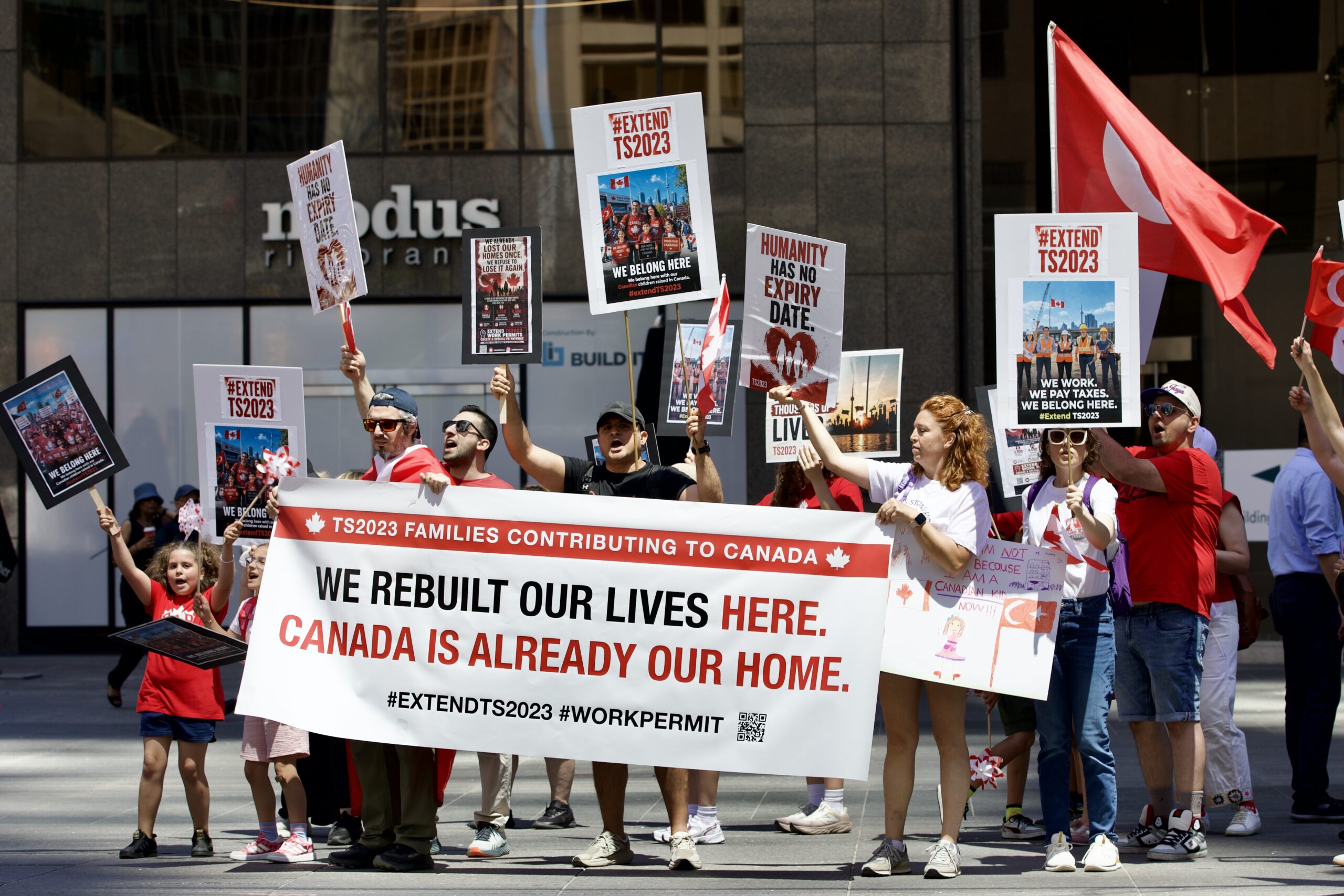
“We work, we pay, let us stay.” That was the chant by children and their parents that echoed into the downtown Toronto sky as more than 200 demonstrators from communities affected by the Türkiye-Syria earthquakes marched from David Pecaut Square to Queen’s Park, urging the federal government to extend open work permits issued after the devastating 2023 earthquakes in Türkiye and Syria.
The federal government’s temporary special measures allowed Turkish and Syrian nationals with valid temporary status in Canada to extend or change their status and apply for fee-exempt open work permits. Applications closed on Jan. 3, 2024, and permit holders whose work authorization is now nearing expiry say existing permanent-residence programs do not give many of them a realistic path to remain.
A House of Commons petition signed by 8,089 people sought a minimum two-year permit extension, access to work permits exempt from the Labour Market Impact Assessment process and consideration of a permanent-residence pathway.
The government responded on June 12 that the measures were always intended to be temporary, and directed affected residents to apply for permanent immigration through existing programs.
The march was organized by members of the Turkish community and included Turkish, Kurdish and Syrian participants affected by the expiry of the federal government’s temporary immigration measures.
Mehmet Emin Atak, a civil engineer who said he works as a consultant on projects at Toronto Pearson International Airport, was one of the demonstrators. Despite working full time and pursuing further qualifications, Atak said he has not found a viable route to permanent residence before his current work permit expires.
“We are working, paying our taxes and contributing to society,” he said. “Just because of the way the system is designed, we are not able to get our permanent residence.”
‘We are already here’
Atak said age-based selection criteria can make it difficult for older applicants to obtain enough points under Canada’s economic immigration programs, even when they are employed in skilled occupations.
He has been studying French and said he took the TEF Canada language test the day before the rally in an effort to improve his immigration prospects.
“I know the government’s recent agenda is to decrease immigration levels, but we are not newcomers,” he said. “We are already here.”
Atak said the group is asking Ottawa to extend its members’ open work permits for at least two years while considering a path to permanent residence for people who have established careers, families and community ties in Canada.
“Our peaceful request is: reconsider our situation and extend our open work permits for another minimum two years,” he said.
The marchers included professionals working in health care, engineering, finance and other industries, Atak said. Some are employed in their original fields, while others have taken related or different work as they navigate Canadian licensing and credential-recognition requirements.
Children rebuilding their lives
For Pınar Karakoç, the uncertainty extends beyond employment and immigration status to the education of her two daughters.
Karakoç, a dentist from Türkiye, said she and her husband came to Canada with their children three years ago. Her younger daughter began school in Canada and learned to read and write in English, while her older daughter had to adjust to a new school and social environment during adolescence.
“Çocukların yeni bir çevreye ayak uydurması hiç kolay olmadı açıkçası başlangıçta,” Karakoç said in Turkish. (“It was not easy for the children to adapt to a new environment, especially at the beginning.”)
The family has since established a life in Canada, she said, and the children have settled into their schools. English is now the younger daughter’s main language for reading and learning.
Karakoç cannot yet practice dentistry in Canada because she must complete the required credential-recognition and licensing process, which is rigorous and incredibly competitive. She said she accepts the requirements and has continued preparing for them while the family supports itself through other types of employment.
“Ben diş hekimi olarak şu an mesleğimi yapamıyorum. Bir takım denklik süreçlerinden geçmem gerekiyor,” she said. (“I cannot currently work as a dentist. I have to go through a number of credential-recognition steps.”)
Her husband, an engineer, works in his profession, she said. Karakoç said the family has paid taxes and established itself through its own resources, without relying on government financial assistance.
“Tamamen kendi imkânlarımızla, kendi gücümüzle, kendimiz çalışarak buradaki sisteme ayak uydurmaya çalıştık,” she said. (“We have worked to adapt to the system here entirely through our own means and our own efforts.”)
Karakoç said existing permanent-residence programs are difficult to navigate for people who arrived in Canada later in their careers rather than as young students.
“Çocuklarımızı burada büyütmek istiyoruz. Yeni bir hayat burada kurduk,” she said. (“We want to raise our children here. We have built a new life here.”)
She wants Ottawa to make the requirements for permanent residence more attainable for permit holders who have already established themselves in the country.
Professional credentials take time
Internationally trained family physician Sima Filizer described a similar struggle to rebuild her professional life.
Filizer attended the demonstration both as a participant and as an informal first-aid provider, carrying medical equipment in case anyone required assistance during the march.
She is not licensed to practise medicine in Canada and currently works full time as an interpreter, primarily in medical settings. Filizer said she recently completed a Canadian medical licensing examination and is also studying French.
“Getting qualified in Canada as a physician takes a lot of time and effort,” she said. “No matter how educated you are, getting to know where to start and how to move forward takes a long time.”
Filizer said the three-year period was not enough for many internationally trained professionals to establish themselves in a new country, find housing and employment, navigate licensing systems and meet the requirements of a permanent immigration program.
“The time that was given to us really wasn’t enough to do all the things that are required for permanent residency,” she said. “To get used to a new country and get everything done here takes a lot of time—for sure more than three years.”
She said internationally trained workers were largely left to navigate professional accreditation, job searches and immigration programs on their own.
“We should have been granted at least a two-year extension to get more qualifications, find our way through the licensing pathways and have the opportunity to do the jobs we used to do in our country,” she said.
Filizer also spoke about the effect another move could have on families whose children have established themselves in Canadian schools.
“They started school here. They really have their own environments and their own living conditions,” she said. “Going back to a new life in Türkiye will be, of course, very hard.”
Measures ended in 2024
When Ottawa first announced its response to the earthquakes, New Canadian Media reported in March 2023 on Turkish and Syrian families hoping the measures would help reunite them with relatives affected by the disaster.
The original measures applied to Turkish and Syrian nationals who were already in Canada with valid temporary status. They could extend their status, move between temporary streams and apply for open work permits without paying the usual application fees.
The measures were initially scheduled to expire in September 2023 but were extended until Jan. 3, 2024.
Applications submitted after that date are processed under regular immigration programs and require the usual fees.
The TS2023 petition for another extension was initiated by Scarborough resident Ali Demircan and presented in the House of Commons by Oakville West MP Sima Acan on April 29.
It asked Ottawa to create temporary permits exempt from the Labour Market Impact Assessment process, extend existing work permits for at least 24 months and consider a permanent-residence pathway for people contributing through employment, education or community involvement.
A Labour Market Impact Assessment is generally used to show that hiring a foreign worker will not negatively affect Canadian workers. Obtaining one can involve costs and administrative requirements for an employer, while an open work permit allows its holder to work in most jobs without an employer-specific assessment.
In its response, the federal government said the earthquake measures had already been extended once and were intended to allow Turkish and Syrian nationals to remain and support themselves temporarily while the affected region recovered.
Eligible people with valid temporary status can apply through regular programs to renew it, the government said, while those seeking to remain permanently may apply through existing immigration pathways.
“When responding to international crises, Canada tailors its approach to meet the unique needs of those affected,” the response said.
The government added that immigration decisions must align with Canada’s immigration levels plan and available program capacity.
Community questions inconsistent treatment
TS2023 advocates are also questioning why Ottawa has renewed or introduced temporary measures for people affected by some other international crises while allowing the Türkiye-Syria policy to end.
Eligible Sudanese nationals in Canada may apply to extend or change their temporary status without application fees until Oct. 27, 2026.
Similarly, Haitian nationals have also been extended until Oct. 27, 2026.
Canada introduced a narrower extension for some Iranian work-permit holders until March 31, 2027, although standard processing fees apply.
Eligible Ukrainians and their family members holding qualifying open work permits may apply for extensions of up to three years, with a March 31, 2027, application deadline.
The eligibility rules and circumstances surrounding those programs differ, but TS2023 advocates say the extensions show that Ottawa can create temporary transitions when people already living and working in Canada remain affected by crises in their home countries.
Filizer said losing the ability to work would unravel much of what families had spent the past three years building.
“From outside, it may seem easy, but please ask us,” she said. “It wasn’t easy at all.”
As the demonstrators continued toward Queen’s Park, parents and children repeated the demand that had brought them into downtown Toronto: “Extend TS2023!”
Filizer said the community plans to continue demonstrating.
“We want to use all the ways that we can to make our voices heard,” she said. “I hope they hear us and extend our work permits.”
Pınar Karakoç spoke in Turkish. Her remarks were translated into English.

Nur Dogan is a Turkish journalist who lives in Toronto. She studied journalism at Humber College. Her stories and photographs were published not only in Canada but also in the U.S. and Europe. As a digital media reporter, she has covered national and international news for some magazines, newspapers and online news platforms. Focusing on human rights for all, Nur observes and reports on human rights violations, oppressions and illegitimate political attempts against visible minorities.